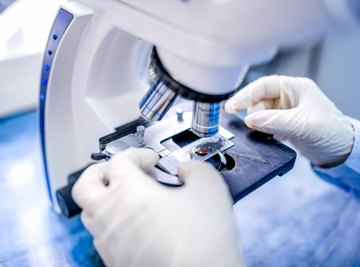

Microbiology studies microscopic organisms and needs ways to distinguish different types visually. Microbiologists use staining procedures that add color to different types of organisms. These stains are chemicals that are of different colors, but these chemicals do not themselves stick to the organisms. Thus, a microbiologists adds a mordant to the stain. A mordant is classically defined as an ion that binds a chemical dye and holds it down, such that the dye remains stuck on the organism. However, any chemical that keeps a dye in place can also be considered as a mordant.
TL;DR (Too Long; Didn't Read)
A mordant "fixes" the dye to the organism, so that they dye is kept in place.
The Bridge
In microbiology, a mordant is a compound used to hold down molecules of a stain onto a microorganism. Classically defined, mordants are usually ions such as metal ions or halide ions, but can be any molecule that serves the purpose of holding down a dye. However, a molecule called phenol is a non-ionic mordant that is discussed below. Some mordants bind both the dye and proteins on the microorganism. Most mordants are ions because the electrical charge on the ion attracts the electrical charge on a chemical dye. Thus, when the ion binds the dye, they form a large complex that precipitates -- meaning they become a solid and are no longer dissolved in the solution. Mordants hold down, or weigh down, the dye so it does not wash away during the remainder of the staining procedure. Washing is done so that only the true staining regions are visualized.
Gram Staining
A very common type of staining in microbiology is Gram staining. Bacteria have cell walls that surround their plasma membrane and give them physical protection. The Gram stain distinguishes between Gram-positive and Gram-negative bacteria. Gram-positive bacteria have thicker cell walls than Gram-negative bacteria. Gram staining is performed when the chemical dye crystal violet is mixed with the mordant iodine. Iodine and crystal violet form a large complex that precipitates out of solution. During the staining procedure, the bacteria are bathed in alcohol, which causes the cell walls to shrink. This shrinkage traps the iodine-crystal violet complex in the cell wall, which gives Gram-positive bacteria a purple color. .
Iron Hematoxylin Staining
Another common stain in microbiology is the iron hematoxylin stain. Hematoxylin stains DNA in the nuclei of microorganisms. Iron hematoxylin visualizes parasites in the fecal matter of humans. Iron is the mordant that keeps hematoxlin from washing away during the staining process. Iron ions are added to hematoxylin in the form of ferrous ammonium sulfate and ferric ammonium sulfate. Ferrous means the iron atom has charge of +2, and ferric means that the iron ion as a charge of +3.
Acid-Fast Stain
Acid-fast staining is used to detect the presence of mycobacteria in sputum, which is a mixture of saliva and mucus that is coughed up. The chemical dye fuschin stains these bacteria, but phenol -- in the form of carbolic acid -- is the chemical that keeps fuschin in the cell wall of mycobacteria. Fuschin dissolves well in phenol, but not water or alcohol. In turn, phenol mixes well with the waxy cell wall of mycobacteria. Thus, phenol serves as a taxi cab that shuttles fuschin into the cell wall. Phenol is not a metallic or halide ion, but serves as a mordant because it keeps the dye in place.
References
About the Author
David H. Nguyen holds a PhD and is a cancer biologist and science writer. His specialty is tumor biology. He also has a strong interest in the deep intersections between social injustice and cancer health disparities, which particularly affect ethnic minorities and enslaved peoples. He is author of the Kindle eBook "Tips of Surviving Graduate & Professional School."