
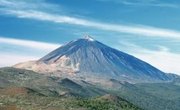
The accumulation of eons of eruptions build volcanoes up around a vent that connects to molten rock deep within the ground. There are many specific signs that a volcano is erupting (in addition to a flow of lava down its sides). Earth tremors, the release of gases and the expulsion of hot lava are some of these indicators.
Before an Eruption
Before a volcano erupts, there is normally an increase in earthquakes and tremors near and under the volcano. These are caused by magma (molten rock) pushing upward through the rock under the volcano. The ground may crack open and allow steam to escape. Gases such as carbon dioxide and hydrogen sulfide, a gas that smells like eggs gone bad, frequently are present and escape in seams along the mountain. Hot springs in the area around the volcano may appear or change in appearance and temperature.
Volcanic Gas
During an eruption of a volcano, gases dissolved in the magma are released into the air. These gases can escape through many different places in the volcano, such as the large opening at the top or vents in the side. The gases are highly pressurized when deep in the earth, but as the magma moves toward the surface the pressure lessens and the gases form bubbles. These bubbles quickly expand and explode upon finally reaching the surface. Volcanic rock called tephra is thrown about by these explosions, with the gases rising high into the air. Winds can then blow this cloud of volcanic gases far from the original point of eruption.
Lava
Molten rock, commonly called lava, streams out of a volcano during an eruption. There does not necessarily have to be explosive activity associated with lava flow, but when there is an explosion, a fountain of lava can come spewing out of the volcano. The intensely hot lava will obliterate everything it comes into contact with. The lava can flow fast or slow depending on its thickness. It may take a confined path or flow in a wide sheet over the ground, according to the terrain. Lava reaching water, such as an ocean or large lake, will pour into it and give off a great deal of steam as the hot substance meets the much cooler water.
Volcanic Landslide
Another sign that a volcano is erupting is a volcanic landslide. During this event, huge amounts of soil and rock break loose from the side of the volcano and fall down the mountain. The speed with which a volcanic landslide can move may break sheets of rocks into fragments that can be small or incredibly huge. These landslides can move fast enough that their own momentum can bring them across entire valleys and up the steep slopes of nearby terrain.
Pyroclastic Flows
When molten or solid rock explodes from a volcano, the result is a pyroclastic flow, a mixture of extremely hot rock and heated gases. This mixture escapes from and then moves away from the vent of an exploding volcano at very high speeds. Pyroclastic flows come in two parts: a flow of fragments that moves along the ground and a flow of hot gases that accompanies it. Everything in the way of a pyroclastic flow is destroyed, as the speed of the material involved is so high and the heat so intense that nothing can withstand the force. Pyroclastic flows usually follow a path through a valley or a low stretch of ground.
Volcanic Ash
Some volcanic eruptions come with volcanic ash, small bits of rock that escape from the volcano, go high into the air and then fall like rain from above. The wind can scatter volcanic ash, which often has a sulfur smell, over a large area. Falling ash can become so dense that it turns the sky gray or black as night. The ash can pile up on buildings, causing roofs to collapse. Rain and lightning can be precipitated by its presence in the atmosphere, making it a particularly scary sign of a volcanic eruption.
References
About the Author
John Lindell has written articles for "The Greyhound Review" and various other online publications. A Connecticut native, his work specializes in sports, fishing and nature. Lindell worked in greyhound racing for 25 years.