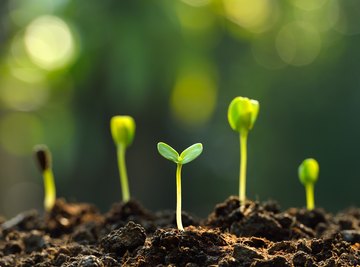

While the specifics can get more complicated, teaching kindergarten students the basics of the plant life cycle is not difficult. Plants are a suitable way to begin learning about the natural world, and the principles learned introduce children to the life cycles of all living things. All plants – from flowers to tall trees – follow similar life cycles.
It Starts With Seeds
Children often view seeds with wonder. These compact organic structures do not look like much, but they hold inside all that is needed to create a brand new plant under the right conditions. Even the food necessary to begin life is packed into seeds. A coating protects the seed from drying out and from injury. Not all plants use seeds to start new individuals, but most do. Mosses produce microscopic spores that spread when the wind blows. Other plants, such as potatoes, start with tubers. Some plants, like ivy, spread with runners.
Young Plants
Seeds wake up during a process called germination. This occurs when the seed has just the right soil temperature, a little oxygen, the right amount of sunlight and enough moisture. Some plants like lots of light; others want just a little. It's the same with water. Some plants are thirsty from the beginning, while others like it drier. The conditions must be right for the particular seed before it can germinate. When that happens, the seed breaks open. Roots poke out of the bottom of the seed, and leaves push their way out of the top. Eventually, the leaves make it out of the soil, and a tiny little plant emerges. The germinated seed has now become a young plant, called a seedling.
Mature Plants
As long as the seedling continues to get the right amount of sunshine, water and food from the soil, it will continue to grow larger and stronger. The plant continues to grow until it reaches the height it is supposed to be. For flowers, that might only be 1 foot tall, but for trees, that might be 50 feet or more. Once the plant is fully grown, it is a mature plant, sometimes called an adult plant. Its roots are deep in the ground and it has all its leaves, which work hard to make food for the plant. The plant can now make its own seeds and start the life cycle all over again. Many produce flowers that bees, butterflies and other animals help pollinate. The result is typically a fruit, which contains the seeds.
Decline
Like all living things, plants decline and die. Some only last a season, and they are called annuals. Many flowers fit in this category. Other plants, such as trees, may live for dozens and even hundreds of years. When mature plants die, it marks the end of their life cycle, but they have given new life to so many other plants of its kind through additional seeds. The old plant continues to give life to other organisms, including other plants, after it dies. Its leaves, stems, roots and other tissues provide nutrients to the soil. Plants of all kinds find the nutrients they need in order to grow from seedlings to mature plants.
References
About the Author
Robert Korpella has been writing professionally since 2000. He is a certified Master Naturalist, regularly monitors stream water quality and is the editor of freshare.net, a site exploring the Ozarks outdoors. Korpella's work has appeared in a variety of publications. He holds a bachelor's degree from the University of Arkansas.