
What Type of Organic Macromolecule Is Glucose?

What Type of Organic Macromolecule Is Glucose? thumbnail
Sucrose Disaccharide

The simple chemical formula for glucose is C₆H₁₂O₆. Glucose is a carbohydrate, specifically a monosaccharide. This is like saying peas are a vegetable, and more specifically a legume--a type of vegetable. Being even more specific, glucose is a simple sugar. It is variably called grape sugar, blood sugar and corn sugar.

  1. Carbohydrates

    • Carbohydrates are the most abundant of the major macromolecules found in the human body. The other three are nucleic acids, proteins and lipids. Macromolecules are often viewed as polymers. Carbohydrates are involved with the storage and transportation of energy.

    Monosaccharides

    • Monosaccharides are the simplest form of carbohydrate: simple sugars. They can not be broken down into simpler carbohydrates. Monosaccharides can be linked together to form disaccharides or even polysaccharides.

    Disaccharides

    • An example of a disaccharide is sucrose, which is a molecule of glucose and fructose combined into a single sugar. Conversely, a molecule of sucrose can be split into a molecule of glucose and one of fructose.

    Glucose Equilibrium

    • Glucose can exist as two forms in equilibrium. Glucose can be a straight chain, and it can be a ring structure. The reason for this is that the straight chain has an alcohol group at one end and an aldehyde group at the other. Those two groups can react with each other, closing the chain. That chain can easily reopen, however. Usually both forms exist together.

    Starch

    • When a number of sugar units join together, they form a particular type of polysaccharide called starch. Plants produce various kinds of starch as energy storage units. Starches can be broken down enzymatically or chemically, into sugars. One example of this is the commercial sweetener high fructose corn syrup.

Related Searches:

References

Resources

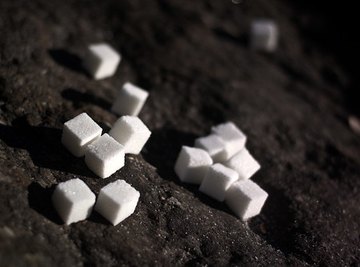
  • Photo Credit Image by Flickr.com, courtesy of David Goehring

Comments

You May Also Like

  • Four Main Classes of Macromolecules

    Every living thing is made up of molecules. In biology, there are four main classes of large molecules called macromolecules that are...

  • Types of Biological Macromolecules

    Macromolecules are an essential part of nutrition. The molecules are categorized as lipids, proteins, carbohydrates and nucleic acids. These macromolecules are ...

  • Macromolecules Found in Living Organisms

    Macromolecules Found in Living Organisms. All living organisms, from bacteria to humans to elephants, contain complex chemical compounds called macromolecules. These ...

  • What Type of Compound Is Sucralose?

    The artificial sweetener sucralose was discovered in 1976. Sucralose has 600 times the sweetening power of cane sugar, yet it contains zero...

  • What Is the Freezing Point of Sucrose?

    Sucrose, or table sugar, is derived from sugar canes and sugar beets. The white crystalline powder is odorless and has a sweet...

  • What Is Glucose Oxidase?

    Glucose oxidase, a once-obscure enzyme, has received increasing attention for its groundbreaking role in home blood glucose monitoring devices for diabetes management...

  • Four Classes of Macromolecules That Occur in Living Organisms

    Four Classes of Macromolecules That Occur in Living Organisms. There are four types of macromolecules: carbohydrates, lipids, proteins and nucleic acids.

  • What Is the Type of Energy Found in a Glucose Molecule?

    There is a law in physics called the Conservation of Energy which says "energy cannot be created nor destroyed." Energy simply exists...

  • How to Make a Macromolecule Concept Map

    A macromolecule concept map provides information about macromolecules by showing relationships. A macromolecule is a molecule, or a group of atoms, that...

  • Why Is Glucose a Molecule?

    Glucose, or blood sugar, has the chemical formula C6H1206. It is a carbohydrate, important in human metabolism. No single element can be...

  • Definition of Simple Sugars

    Simple sugars are a type of carbohydrate, according to the University of Maryland Medical Center (UMMC). Carbohydrates are the body's main energy...

  • Fructose Structure Description

    Fructose is a natural sugar/carbohydrate commonly found in fruits. Fructose is known as a monosaccharide, ketose sugar and reducing sugar.

  • Structure of Glucose Permease

    Because molecules of glucose have two hydroxyl (OH) groups attached, they are too polar to achieve crossing the lipid bilayer of a...

  • Types of Monomers

    Monomers are single atoms or small molecules that bind together to form polymers, macromolecules that are composed of repeating chains of monomers....

  • What Type of Organic Compound Is Glucose?

    Glucose is a monosaccharide, a simple sugar, made available to the body through the digestion of carbohydrates. Glucose provides the majority of...

  • What Is a Byproduct of Condensation of Two Molecules of Glucose?

    When two glucose molecules undergo a condensation reaction, a single water molecule (H2O) is given off as a byproduct. Glucose structure and...

  • What Kind of Saccharide Is Glucose?

    Glucose is a monosaccharide and an extremely important carbohydrate in biology. It's used as a source of chemical energy by virtually all...

  • What Elements Make Up Glucose?

    What Elements Make Up Glucose?. Glucose, also called grape sugar, blood sugar or corn sugar, is among the simplest and one of...

  • What Are the Properties of Organic Molecules?

    Organic chemistry deals with carbon compounds. Although some inorganic molecules contain carbon, organic molecules are characterized by carbon atoms bonded to other...

Related Ads

Featured