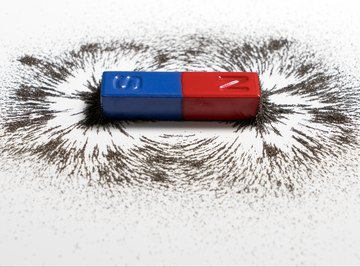

Magnetism astounds everybody when they first encounter it. Magnets attract some objects as if by magic, but only specific materials respond to a magnet. Understanding which materials respond and which don’t is quite simple, but it depends on an understanding of how magnets work in general. While most people know that metals are attracted to magnets, in reality, “ferromagnetic” metals like iron are the main metals that are attracted to them, although paramagnetic and ferrimagnetic (with an "i," not an "o") metals do have a weak attraction to magnets, too.
TL;DR (Too Long; Didn't Read)
Iron, cobalt and nickel, as well as alloys composed of these ferromagnetic metals, are strongly attracted to magnets. Other ferromagnetic metals include gadolinium, neodymium and samarium.
Paramagnetic metals are weakly attracted to magnets, and include platinum, tungsten, aluminum and magnesium.
Ferrimagnetic metals like magnetite are also attracted to magnets, while diamagnetic metals like silver and copper are repelled by them.
How Magnetism Works
Understanding magnetism is essential if you want to know why some metals are attracted to magnets and others aren’t. The motion of electrons in an atom produces a small magnetic field, but ordinarily, this field is cancelled out by the motion of other electrons and their opposing magnetic fields. However, in some materials, when you apply a magnetic field, the spins of neighboring electrons align with one another, which produces a net field across the whole material. In short, instead of cancelling each other’s fields, the electrons in these materials join together and make a stronger field. In some materials, this alignment disappears when the field is removed, but in others, it remains even after the field has been removed.
Magnets have positive and negative poles (or north and south poles), and as most people know, matching poles repel each other while opposite poles attract one another.
Ferromagnetic Metals and Alloys
Ferromagnetic materials are attracted to magnets because their electrons spin and the resulting “magnetic moments” align easily, and retain that alignment even without an external magnetic field. Ferromagnetic materials such as iron, nickel and cobalt are therefore attracted to magnets, as well as rare-earth metals like gadolinium, neodymium and samarium.
Alloys made from these materials are also attracted to magnets, so stainless steel with substantial amounts of iron in (as opposed to chromium, for example) is attracted to magnets. Other ferromagnetic alloys include awaruite (nickel and iron), wairauite (cobalt and iron), alnico (cobalt, iron, nickel, aluminum, titanium and copper) and chromindur (chromium, cobalt and iron). Essentially, any alloy composed of ferromagnetic materials will also be magnetic.
Paramagnetic Metals and Magnetism
Paramagnetic metals have a weaker attraction to magnets than ferromagnetic metals, and they don’t retain their magnetic properties in the absence of a magnetic field. Paramagnetic metals include:
- platinum
- aluminum
- tungsten
- molybdenum
- tantalum
- cesium
- lithium
- magnesium
- sodium
- uranium
Ferrimagnetic Metals and Magnetism
Some materials are classed as ferrimagnetic. This occurs when an ionic compound has two lattices of material with opposing magnetic moments, but the two are not completely balanced, leading to a net magnetization. Magnetite provides an example of this type of magnetism, and it was originally considered a ferromagnetic material because of the similarities between these two types of magnetism. However, many ferrimagnetic materials are ceramics rather than metals.
Diamagnetic Metals and Magnetism
Diamagnetic metals are actually repelled by magnets rather than attracted to them, and usually weakly. Materials are classed as diamagnetic when their magnetic moments act in opposition to the field applied rather than to enhance it. These materials include silver, lead, mercury and copper.
References
- University of Wisconsin-Madison: The Wonders of Physics: What Is Magnetism?
- University of Maryland: TerpConnect: Is Nickel Magnetic?
- Georgia State University HyperPhysics: Ferromagnetism
- Engineering LibreTexts: Ferrimagnetism
- University of Minnesota: Classes of Magnetic Materials
- Georgia State University HyperPhysics: Magnetic Susceptibilities of Paramagnetic and Diamagnetic Materials at 20°C
- U.S. Energy Information Administration: Magnets and Electricity
About the Author
Lee Johnson is a freelance writer and science enthusiast, with a passion for distilling complex concepts into simple, digestible language. He's written about science for several websites including eHow UK and WiseGeek, mainly covering physics and astronomy. He was also a science blogger for Elements Behavioral Health's blog network for five years. He studied physics at the Open University and graduated in 2018.