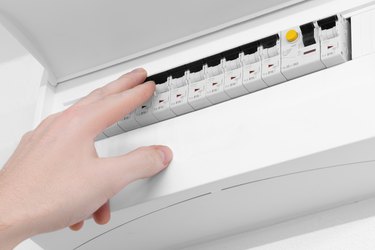
To understand what a circuit breaker AIC is, one must first know what a circuit and a circuit breaker are. Electric circuits are paths for transferring electric currents. They include a device that provides energy to the charged particles that make up the current, like a generator or a battery. They also have transmission lines or connecting wires plus the devices that use the currents, like computers and electric motors. Circuit breakers are vital because they are used to cut off the power when needed. Without these (or fuse boxes), people would not be able to use electricity in a home or building safely.
What Is a Circuit Breaker?
Video of the Day
When electricity enters a building, it enters a circuit breaker box or fuse box, and from there, the electrical wiring divides it into different circuits. A breaker or fuse protects each of these. Rooms that use less electricity, like bedrooms, usually have 15-amp circuits, while ones that use more, such as kitchens or bathrooms, generally have 20-amp circuits. Any of these can get overloaded, which could lead to a fire. That's why circuit breakers are so important; they sense the extra current and trip to halt power flow.
Video of the Day
A basic circuit breaker has a switch connected to an electromagnet or a bimetallic strip. With an electromagnet, the circuit's hot wire connects to both ends of the switch. When the switch is on, electricity flows from the breaker's bottom terminal to the electromagnet, the moving contact, stationary contact and then up to its upper terminal. Electricity magnetizes that electromagnet, and the more current there is, the more magnetic force. With unsafe levels, the electromagnet pulls down a lever that shuts off the electricity; if there's a bimetallic strip instead of an electromagnet, it works in the same way.
What Is Ampere Interrupting Capacity?
Ampere interrupting capacity (AIC) refers to circuit breakers and fuses, and when a product shows an AIC rating, it includes circuit protection. These ratings generally range from 5 to 200K AIC. The number describes the maximum fault current that the circuit can clear safely with the welding closed or causing damage to personnel or equipment. For example, a meter main with a 20K AIC can interrupt currents up to 20,000 amps without exposing live parts or shorting to the ground.
Short-circuit current ratings (SCCR) are on meter mains and meter sockets and indicate whether there is a disconnect that shuts off the power completely. Breakers in meter mains have AIC ratings that limit the SCCR. The SCCR is effectively a measure of the maximum fault current that the meter can withstand or the feed supply's maximum available fault current. If a meter socket's SCCR is 10K, that socket can stand up to a three-cycle surge of up to 10,000 amps going through it without any immediate danger or breakdown.
AIC vs. SCCR Ratings
AIC and SCCR are two different rating systems, and for those who aren't certified electricians, it can be particularly challenging to distinguish between them. The main difference is that an AIC rating applies to the breaker that is inside the meter main only. The SCCR applies to the whole meter main.
While an AIC rating can be higher than that overall SCCR, the SCCR cannot be higher than the AIC. Both can be the same, though. If the AIC rating and the SCCR are both rated at 20K, the particular breaker would disconnect or interrupt the current or amperage with faults or surges up to 20K. However, the SCCR at that rating means that the entire unit can handle a surge of up to 20K amps. That means that if a circuit with an AIC rating of 20K had a surge of 19K, the rest of the electrical on the main would need to total less than 1K, or the entire system would turn off to prevent significant damage.