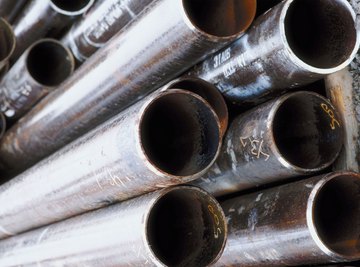
Steel is an alloy, a combination metal made of iron and carbon. The carbon content of steel reaches a maximum of 1.5 percent. Because of its hardness and strength, steel is used in the construction of buildings, bridges, automobiles, and a host of other manufacturing and engineering applications.
Most steel produced today is plain carbon steel or simply carbon steel. The carbon in steel exists in the iron carbide state. Other elements, among them sulfur, phosphorus, manganese and silicon, are present as well.
Carbon Content of Steel
Carbon steel is defined as steel that has its properties mainly due to its carbon content and does not contain more than 0.5 percent of silicon and 1.5 percent of manganese. The plain carbon steels, which range from 0.06 percent carbon to 1.5 percent carbon, are divided into four types:
- Dead mild steel, up to 0.15 percent carbon
- Low-carbon or mild steel, 0.15 percent to 0.45 percent carbon
- Medium-carbon steel, 0.45 percent to 0.8 percent carbon
- High-carbon steel, 0.8 percent to 1.5 percent carbon
These steels progress from softer to harder, but they also trend toward increasing brittleness. The first type is used in automobile bodies. The second type is found in rails and rail products such as couplings, crankshafts, axles, gears and forgings. The third type is used in cutting tools and railway lines, and the last type is used in pistons and cylinders.
Basic Physical Properties of Steel
Steel has a density of 7,850 kg/m3, making it 7.85 times as dense as water. Its melting point of 1,510 C is higher than that of most metals. In comparison, the melting point of bronze is 1,040 C, that of copper is 1,083 C, that of cast iron is 1,300 C, and that of nickel is 1,453 C. Tungsten, however, melts at a searing 3,410 C, which is not surprising since this element is used in light bulb filaments.
Steel's coefficient of linear expansion at 20 C, in µm per meter per degree Celsius, is 11.1, which makes is more resistant to changing size with changes in temperature than, for example, copper (16.7), tin (21.4) and lead (29.1).
Stainless Steel
Stainless steels are employed in construction when corrosion resistance is a major asset, as with knives that must maintain a sharp edge. Another common reason stainless steels are used is their high-temperature properties. In some projects, high-temperature oxidation resistance is an absolute requirement, while in others, high-temperature strength is a primary need.
Additives to Steel
Small amounts of other metals added to steel change its properties in ways favorable to certain industrial applications. For example, cobalt results in higher magnetic permeability and is used in magnets. Manganese adds strength and hardness, and the product is suitable for heavy-duty railway crossings. Molybdenum maintains its strength at high temperatures, so this additive is handy when making speed drill tips. Nickel and chromium resist corrosion and are usually added in the manufacture of steel surgical instruments.
References
About the Author
Kevin Beck holds a bachelor's degree in physics with minors in math and chemistry from the University of Vermont. Formerly with ScienceBlogs.com and the editor of "Run Strong," he has written for Runner's World, Men's Fitness, Competitor, and a variety of other publications. More about Kevin and links to his professional work can be found at www.kemibe.com.
Photo Credits
Jupiterimages/Photos.com/Getty Images