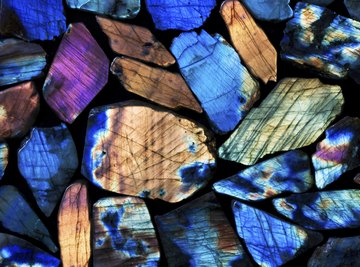
Virginia is a nature-lover's paradise, with the Blue Ridge Mountains and Shenandoah Valley offering a wealth of opportunities for exploration. If you're a gemstone or mineral hunter in "Old Dominion," you're in luck -- as of 2014, some 425 species or minerals had been reported. Maximize your chances of adding to your collection by first arming yourself with the right tools and then heading to established collection hot-spots.
Getting Started
The Virginia Division of Mineral Resources is a great starting point for mineral-hunters.The DMR offers topographical maps and up-to-date reports on gems and minerals -- the very building blocks of the rocks making up the landscape -- throughout the state. For example, you can determine where people have found specific types of minerals. You can even talk to staff geologists to answer questions about Virginia's geological history as well as specific minerals and their locations.
Common Minerals and Gems
Look for amazonite, a greenish-blue type of feldspar, near the town of Amelia. Epidite is a pistachio-green mineral and a component of unakite, Virginia's official state rock. Search for Kyanite, a pale-blue crystal mineral found in metamorphic rocks such as gneiss, in Buckingham County. Patrick County is home to lots of the brownish-black "fairy stones" of staurolite. Along with feldspar and garnet, you can unearth mica -- distinctive for its "platy" appearance -- in the state's Piedmont and Blue Ridge Provinces. The same region is a popular hunting spot for gold, possibly Virginia's most popular mineral.
Where to Look
Naturally, you need permission from the landowner before going mineral-hunting on private property. National parks are off-limits, but it's okay to look for gems and minerals in national forests and on state lands as long as you obtain a research permit. In terms of specific locations, the best place to collect minerals is at commercial collecting areas. Abandoned mines and quarries, mine dumps, stream beds, riverbanks, highway cuts and construction-site excavations are fertile areas -- but be certain to make safety a priority. You may also have luck finding specimens in plowed fields, particularly after a heavy rain.
Identifying Minerals
If you happen upon a good find, you may need help determining just what you've discovered -- unless you're an experienced rock-hound. Common traits that distinguish gems and minerals from one another include color, luster, hardness and density. Minerals also differ in characteristics such as how they cleave or fracture. Some minerals are magnetic and some have electrical properties. Some glow under ultraviolet or black light, some are radioactive and some fuse together under a low flame. Clearly, you won't be able to determine all of these qualities in the field, so you can plan on enlisting an expert to help you.
References
About the Author
Michael Crystal earned a Bachelor of Science in biology at Case Western Reserve University, where he was a varsity distance runner, and is a USA Track and Field-certified coach. Formerly the editor of his running club's newsletter, he has been published in "Trail Runner Magazine" and "Men's Health." He is pursuing a medical degree.
Photo Credits
Joanna-Palys/iStock/Getty Images