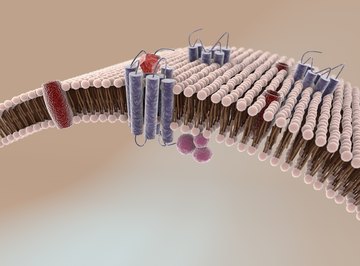
The cellular processes inside the bodies of humans, animals and even fish depend on the formation of adenosine triphosphate (ATP). This complex organic chemical can convert into less complex mono- and di-phosphates, releasing energy that the organism consumes. It is also involved in the production of DNA and RNA. ATP is one of the by-products of cellular respiration, for which the raw ingredients are glucose and oxygen.
TL;DR (Too Long; Didn't Read)
During cellular respiration, one glucose molecule combines with six oxygen molecules to produce water, carbon dioxide and 38 units of ATP. The chemical formula for the overall process is:
C6H12O6 + 6O2 --> 6CO2 + 6H2O + 36 or 38 ATP
Chemical Formula for Respiration
Glucose, a complex sugar, combines with oxygen during respiration to produce water, carbon dioxide and ATP. The combination of one glucose molecule with six molecules of gaseous oxygen produces six water molecules, six carbon dioxide molecules and 38 molecules of ATP. The chemical equation for the reaction is:
C6H12O6 + 6O2 --> 6CO2 + 6H2O + 36 or 38 ATP molecules
While glucose is the main fuel for respiration, energy can also come from fats and proteins, although the process is not as efficient. Respiration proceeds in four discrete stages and releases about 39 percent of the energy stored in the glucose molecules.
Four Stages of Respiration
Although the main process of cellular respiration is essentially an oxidation reaction, four things have to happen, so you can make the full potential amount of ATP. These comprise the four stages of respiration:
Glycolysis occurs in the cytoplasm. One glucose molecule breaks down into two molecules of pyruvic acid (C3H4O3). This process results in a net production of two molecules of ATP.
In the transition reaction, pyruvic acid passes into the mitochondria and becomes Acetyl CoA.
During the Krebs cycle, or citric acid cycle, all the hydrogen atoms in the Acetyl CoA combine with oxygen atoms, producing 4 molecules of ATP and nicotinamide adenine dinucleotide hydride (NADH), which gets further broken down in the final stage. This produces waste carbon dioxide and water in the cycle that must you need to expel.
The fourth stage, the electron transport chain produces the bulk of the ATP. This complex process occurs inside the mitochondria.
After lipases in the bloodstream break them down, fats can become Acetyl CoA through complex processes and enter the Krebs cycle to yield amounts of ATP comparable to those produced from glucose. Proteins can also produce ATP, but they must first change to amino acids before being available for respiration.
References
About the Author
Chris Deziel holds a Bachelor's degree in physics and a Master's degree in Humanities, He has taught science, math and English at the university level, both in his native Canada and in Japan. He began writing online in 2010, offering information in scientific, cultural and practical topics. His writing covers science, math and home improvement and design, as well as religion and the oriental healing arts.