Function of Alcohol
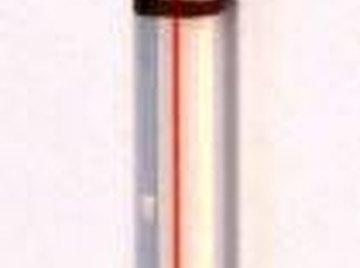
The most common liquid used in common household thermometers used to be mercury, but because of that material's toxicity, it has been replaced by alcohol, or ethanol. An alcohol thermometer is a small sealed tube made of glass that has a small hollow bulb on one end and a thin capillary opening running through the length of its center. The bulb and connected capillary chamber are filled partly with ethanol and partly with nitrogen and ethanol vapors. Enough alcohol is placed in the bulb so that at normal room temperatures it will extend into the narrow column. Along the length of the column, the tube is graded with several marks showing the temperature of the liquid at certain volumes. Because ethanol is very sensitive to changes in temperature, and because the capillary is so thin that even subtle shifts in the overall volume produce a noticeable movement of the dividing line between the liquid and gas in the chamber, it is fairly easy to read the temperature by comparing this dividing line with the marked edge of the tube. For ease of reading, and out of tradition, the alcohol is usually dyed red.
Function
An alcohol thermometer is limited in its usefulness to the freezing and boiling points of the liquid inside it. Ethanol vaporizes at 172 degrees F, well short of water's boiling point. This makes the alcohol thermometer an effective tool for measuring day and nighttime temperatures, as well as the temperature of the human body, but not particularly useful in lab settings where more extreme temperatures must be observed. The lower end of the effective range is -175 degrees F, but reliable use is typically from about -22to 122 degrees F. It is not uncommon for an air bubble inside the inner column to enter the alcohol, which would throw off the reading. For this reason, an alcohol thermometer has to be periodically shaken to keep the air and liquid contents separate.
About the Author
Joseph Nicholson is an independent analyst whose publishing achievements include a cover feature for "Futures Magazine" and a recurring column in the monthly newsletter of a private mint. He received a Bachelor of Arts in English from the University of Florida and is currently attending law school in San Francisco.