
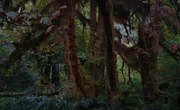
The main attraction of Redwood National Park is the coastal redwood (Sequoia sempervirens), one of the tallest trees on the planet. Along with Sitka spruce and Douglas Fir, these conifers form the dominant canopy of the coastal redwood biome, a distinct ecosystem that grows in the coastal fog belt of northern California.
The Park
The Redwood National Park is located in northern California, just south of the Oregon State Line. Established in 1968, the protected area consists of 131,983 acres (federal, 71,715 acres; state, 60,268 acres). The park habitat includes a coastal shoreline and grassland prairie, which lacks the tall trees, as well as some classic old-growth forest located along Redwood Creek, Mill Creek, Prairie Creek, Klamath River and the South Fork of the Smith River. The park area is not continuous, but contains different units, which are under both state and federal control.
Coastal Redwood Biome
The old-growth redwood forest of the northern California coast consists of two giant coniferous evergreens, the coastal redwood and the Sitka spruce. The coastal redwood is by far the tallest, often reaching a height of 300 feet. The Sitka spruce is slightly smaller with a maximum height of 275 feet. These forests to not grow right on the coastline because of a low tolerance for salt, but can be found along watercourses within a few miles of the Pacific Ocean. The sparse understory, under the forest canopy, consists of red alder, thimbleberry and salmonberry, which provide nourishment for wildlife. Second-growth forests in the park may contain hemlock, Douglas fir and Western red cedar.
Wildlife of the Redwood Forest
The redwood-Sitka spruce old-growth forests of northern California are a fascinating ecological zone because the canopy holds just as much interest to the wildlife biologists as the forest floor. Common birds of the forest are the stellar jay, chestnut-backed chickadee, winter wren, Northern spotted owl and the varied thrush. Also present are the raccoon, chickaree, big brown bat, bobcat, gray fox and the black bear, as well as several species of frogs, newts and salamanders.
Fire Ecology
The redwood develops thick bark at an early age, which not only helps prevent insect attacks, but also acts as protection during a ground fire. Summer forest fires can occur along the coast and help the redwood tree survive because other tree competitors are more susceptible to fire damage. Redwood trees also sprout new needles quickly after a fire. This is a rare trait for a conifer that gives the tree another ecological advantage after a burn. Fire suppression in the redwood stands has made these trees more susceptible to disease and catastrophic large fires.
Fog Belt
The summer fog that occurs along the coast and adjacent river valleys is an important factor in determining where the large redwood and Sitka spruce grow. Despite an annual rainfall that exceeds 60 inches a year, the redwoods seem to be most at home in the coastal valleys, where summer fog is a daily occurrence. In fact, the redwood has adapted to the presence of fog, and during the dry summer months, the branches are able to obtain a substantial portion of its water intake from airborne moisture.
References
About the Author
Henri Bauholz is a professional writer covering a variety of topics, including hiking, camping, foreign travel and nature. He has written travel articles for several online publications and his travels have taken him all over the world, from Mexico to Latin America and across the Atlantic to Europe.
Photo Credits
Redwoods image by Towards Ithaca from Fotolia.com