Structure & Function of Nucleic Acids

Structure & Function of Nucleic Acids thumbnail
Structure & Function of Nucleic Acids

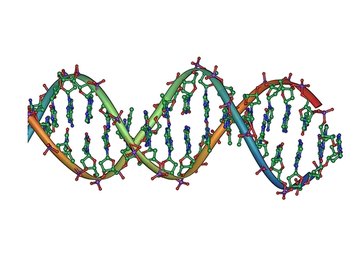
The two natural types of nucleic acids are deoxyribonucleic acid (DNA) and ribonucleic acid (RNA). In animals, DNA forms a double helix while RNA is single-stranded. DNA and RNA also differ in the molecular units used to store genetic information (nucleotides).

  1. Structure of DNA

    • Nucelotides are the alphabet with which the genetic code is written. The DNA double helix has nucleotides on the inside, held in place by backbones on the outside made of sugars and phosphate groups. The double structure facilitates cell division.

    Complementary Structure

    • Each nucleotide can sit opposite only its complement. (For example, adenine can share a step in the spiral with thymine; cytosine is the complement of guanine.) If one nucleotide is damaged, gene-repair mechanisms can identify the damaged nucleotide by its complementary nucleotide.

    Function of DNA

    • DNA stores genetic code, which serves as blueprint for protein production elsewhere in the cell.

    Function of mRNA

    • Messenger RNA (mRNA) directly copies the genetic code from DNA before exiting the nucleus to create proteins outside. This enables DNA to remain behind, safe in the nucleus.

    Function of tRNA

    • mRNA moves to organelles called "ribosomes," where proteins (polymers of amino acids) are actually manufactured. Transfer RNA (tRNA) are nucleic acids that carry and attach amino acids to the mRNA, which acts act as a protein-building template.

    Structure of tRNA

    • tRNA is usually 70-90 nucleotides long, which is much shorter than mRNA. It comes in at least 20 varieties, corresponding to the 20 amino acids that are the building blocks of all proteins.

Related Searches:

References

Resources

  • Photo Credit ghutchis/Flickr.com

Comments

You May Also Like

  • Nucleic Acid Functions

    The human body is made up of millions of cells that work to maintain the body's overall system and function. Each cell,...

  • Structure of Nucleic Acids

    Nucleic acids are polymers (chains) of nucleotides. The most common nucleic acid chains are RNA and DNA. These structures are the essential...

  • Biological Importance of Nucleic Acids

    Nucleic acids carry genetic information within their structure. All living things have some form of nucleic acids, which allow for the translation...

  • Role of Nucleic Acids

    Nucleic acids, more commonly known as DNA and RNA, are the genetic information banks of the cell. They are involved in repair...

  • What Are Examples of Nucleic Acids?

    What Are Examples of Nucleic Acids?. Johann Friedrich Miescher discovered DNA in the nineteenth century. He called it nuclein because he found...

  • The Differences Between Nucleic Acid and a Nucleotide

    A chemical coding system is used universally by every living organism on Earth. The system is similar among the different species, but...

  • Definition of Nucleic Acids

    Nucleic acids are some of the most significant molecules found in living organisms. Their role is to store and transmit genetic information...

  • Uses of Nucleic Acid

    Essential bodily functions such as growth, repair and reproduction all rely on nucleic acid for direction and support. Nucleic acid is in...

  • Components of Nucleic Acids

    Components of Nucleic Acids. Nucleic acids are often called "the building blocks of life." It's an apt title considering that DNA contains...

  • Use of Nucleic Acids

    The two main types of nucleic acid are deoxyribonucleic acid (DNA) and ribonucleic acid (RNA). They store and convey the genetic code...

  • Elements of Nucleic Acids

    Elements of Nucleic Acids. The class of organic compounds known as nucleic acids consists of polymers constructed from nucleotides. Among the best-known...

  • DNA Structure & Function

    DNA is the commonly used acronym for deoxyribonucleic acid. DNA contains the genetic information of an organism, according to Minnesota State University....

  • Characteristics of Nucleic Acids

    Characteristics of Nucleic Acids. Nucleic acid, so named because it is found in a cell's nucleus, is a catch-all term for DNA...

  • Nucleic Acid Facts

    Nucleic acids hold the basic building blocks for life. Deoxyribonucleic acid (DNA) and ribonucleic acid (RNA) are found in all cells. DNA...

  • Nucleic Acids in Human Body Systems

    The nucleic acids most prominent within the human body system are DNA and RNA. These materials are responsible for maintaining and reproducing...

  • Use of Nucleic Acid

    According to the History of Nucleic Acids, nucleic acids (the main players in the protein synthesis in living organisms) were first discovered...

  • What Is the Importance of Nucleic Acids?

    Nucleic acids are vital for cell functioning, and therefore for life. There are two types of nucleic acids, DNA and RNA. Together,...

  • Proteins, Carbohydrates, Lipids & Nucleic Acids Information

    Proteins, carbohydrates, lipids and nucleic acids are important components of the human body. Each are essential to keep the human body functional...

  • What Is the Function of Stomach Acid?

    Stomach acid, also called gastric acid (since the stomach is part of the body's gastrointestinal system), is a fluid secreted by the...

Related Ads

Featured