Neptune – like every object in the solar system – has a unique and colorful history, but most of it is sadly unknown to almost all of the general public. When it was discovered in 1846 (and how this happened represented a technological and conceptual leap forward in itself), it became the eighth and most-distant planet in the known solar system.
After Pluto's discovery in he first half of the 20th century, Neptune became the second-farthest known planet from the sun, but reclaimed the top honor in 2006 when Pluto was reclassified as a dwarf planet. Yet this is only one of the range of Neptune facts that should compel any student of astronomy, or for that matter anyone with a casual interest in the history of faraway worlds, to take up a study of the solar system's windiest planet.
Thanks to Pluto being booted from the "planet club," Neptune is now the only planet that cannot be seen with the unaided eye. (Uranus, which is the second-farthest planet from the sun and similar in many characteristics, can occasionally be spotted at opportune times by those with eagle eyes.)
Organization of the Solar System
The sun is at the center of the solar system. It is an ordinary object by the standards of stars, but it constitutes the overwhelming majority of the solar system's mass. It, and the planetary system around it, are believed to have coalesced from free-floating interstellar matter about 4.6 billion years ago. As some objects began to assume massive forms thanks to rotational forces and the increasing contribution of gravity, the newly formed planets began to assume stable orbits around the sun.
Those orbits are sometimes presented as circular in models for simplicity, but none of them are quite circular. All of them, instead, are elliptical to varying degrees. In fact, because Pluto's orbit is so elliptical, even before it was demoted to a dwarf planet, it was sometimes closer to the sun than Neptune; Pluto's extreme eccentricity of orbit is, in fact, one of the reasons it was moved to a different category in 2006.
The solar system is easy to think of in terms of semi-symmetrical sets: four smaller, rocky inner planets and four huge, mostly gassy outer planets, with an asteroid belt separating the two sets.
Discovery of Neptune
Neptune was discovered on September 23, 1846, but more than that, it was predicted. Its finding was the collaboration of a French astronomer, Alexis Bouvard, and the German astronomer Johann Galle.
Bouvard had noticed irregularities in the orbit of Uranus that could seemingly only result from the gravitational pull from a large, as-yet unknown distant body. Galle then performed a number of intricate mathematical calculations – without the help of computers, of course – to finally place Neptune in the cross-hairs of a telescope.
- Interestingly, Galileo Galilei, considered the father of modern astronomy, may have spotted Neptune over 200 years earlier in one of his own less-powerful telescopes, based on one of his sketches. If so, however, Galileo understandably mistook the object for a star.
Neptune, as had become a tradition, was named after a god of the ancients. Neptune was the Roman god of the seas and was known to the Greeks as Poseidon.
Neptune Facts and Figures
Neptune is about 30 times farther from the sun than the Earth, with an orbital radius of about 2.7 billion miles. Sunlight takes about four hours to reach the planet. It is about four times as wide as the Earth; that may not sound like that great a difference, but given that the volume of a sphere is proportional to the third power of the radius, the implication is that about 4 × 4 × 4 = 64 Earth-sized planets could fit inside Neptune – think of a tennis ball next to a basketball.
- Despite Neptune's considerable size, it completes one rotation in only 16 hours, making a Neptunian day only two-thirds as long as an Earth day.
Neptune zips around the sun at a speed of over 12,000 miles an hour. Its axis of rotation is tilted away from the direction perpendicular to the plane of its orbit around the sun by about 28 degrees, a little more than Earth is. This means that if you could look at a video of Neptune orbiting the sun shot from outside and directly "beside" the solar system, it would appear to be leaning in one direction the whole time, about a quarter of the way toward being completely "sideways."
- So far, the only Earth-launched spacecraft to do a fly-by of Uranus was Voyager II, in 1989.
Neptune Characteristics up Close
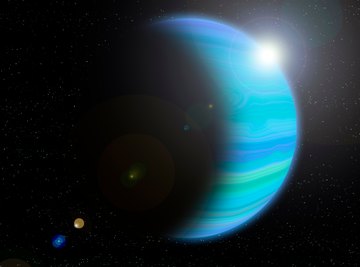
Neptune is classified as a gas giant, or a "Jovian" planet, that word meaning "Jupiter-like." The four planets farthest from the sun – in increasing order of distance, Jupiter, Saturn, Uranus and Neptune – all consist of a solid metal-and-rock core surrounded by a great deal of gas and ice that makes up most of these planets' volumes. For Neptune, much of this consists of hydrogen, helium and methane, which is why it appears a characteristic blue color through a telescope.
Neptune is extraordinarily windy, with surface gusts believed to reach 1,300 miles per hour, on a par with the speed of military fighter jets and faster than many firearms. This is about five times as fast as the highest-recorded wind speed on Earth. Scientists remain unsure of the reasons for Neptune's high wind speeds along with the unusual characteristics of its magnetic field.
Neptune's Moons
Neptune boasts of 14 moons as of 2019, with the largest, Triton, being the second-largest moon in the solar system. Triton is unique among large moons in the solar system in that it orbits Neptune in the opposite direction that Neptune itself rotates. This phenomenon is known as retrograde motion, and in the case of Triton suggests that it may have started its life as something other than a moon before being captured by Neptune's gravity.
Triton has a thin atmosphere of its own. It was discovered only 17 days after Neptune itself was. In those days, the space "arms race" consisted not of developing spacecraft that could actually achieve a stable orbit around the Earth, but of making better and better telescopes and thus positioning their possessors to make groundbreaking discoveries.
Triton is one of the coldest places in the solar system, with temperatures on its surface dipping down to –360 F (–218 C). Nevertheless, Voyager II's mission detected suggestions of volcanic activity beneath the moon's surface.
- In addition to the 13 smaller moons, Neptune is orbited by five distinct rings of dust, small rocks and ice, though these do not boast the grandeur of the iconic rings of Saturn.
Neptune in Popular Culture
Although Neptune lacks the apparent allure to automakers and other manufacturers possessed by other heavenly bodies, no doubt thanks to its relative obscurity, it still pops up now and again in pop culture. Perhaps the most famous instance to date is the 1997 film Event Horizon, a thriller in which Neptune served as a backdrop.
References
About the Author
Kevin Beck holds a bachelor's degree in physics with minors in math and chemistry from the University of Vermont. Formerly with ScienceBlogs.com and the editor of "Run Strong," he has written for Runner's World, Men's Fitness, Competitor, and a variety of other publications. More about Kevin and links to his professional work can be found at www.kemibe.com.