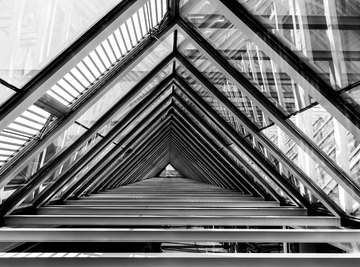

Geometry and architecture are two disciplines that are fundamentally linked. One of the most recognized geometric shapes is the triangle. Triangles are identified by the three angles that are linked through line segments to form a three-sided shape. The two most common triangular forms used in architecture are equilateral and isosceles.
Triangles and Architecture
Triangles are effective tools for architecture and are used in the design of buildings and other structures as they provide strength and stability. When building materials are used to form a triangle, the design has a heavy base and the pinnacle on the top is capable of handling weight because of how the energy is distributed throughout the triangle. This is why many residential homes have A-frames; it provides a sturdy structure. The most sturdy of the triangles are equilateral and isosceles; their symmetry aids in distributing weight.
Equilateral Triangle
The equilateral triangle is by far the most common triangle used in architecture. An equilateral triangle features three congruent sides and angles measuring 60 degrees on each corner. The lengths of the sides vary. A common example of equilateral triangles used in architecture is the Pyramid Complex of Giza in Egypt. Each of the four triangular sides that form the pyramids are equilateral triangles. These are examples of the strength of the triangle in architecture as the pyramids have been standing for over 4,000 years.
Isosceles Triangle
Isosceles triangles, which have two equal sides, are also found in architecture throughout the world, especially in modern pyramidal architecture. Isosceles triangles were used in the architecture of the East Building in the National Gallery of Art in Washington, D.C. The building was designed by the famous architect I.M. Pei. His architectural style featured the use of isosceles triangles and other geometric shapes. The East Building was plotted on an oddly shaped piece of land. Pei used an isosceles triangle also as the base of the building to accommodate the shape of the plot. The Flatiron Building in New York City is one of the world’s groundbreaking skyscrapers. This building is built on a triangular block in Manhattan, giving it a triangular shape, specifically, an isosceles. It has stood over 100 years, illustrating the strength of triangular architecture.
Scalene and Right Angle Triangles
A scalene triangle is one in which all sides are incongruent. Scalene triangles are not commonly found in architecture. There is no symmetry in these triangles, causing an uneven distribution in weight. This is hazardous as one angle will have more weight and pressure placed on it than another. Right angle triangles have one angle that is a perfect 90 degrees. These special triangles are not traditionally used in the structural characteristics of a building. They are, however, vital to the construction and design of the building. Right triangles are used to create perfect corners and straight lines. If the walls and corners of a building are crooked, the building also will be crooked.
Additional Information
Triangles are also used as adornments in architecture, not just in the foundational design. In churches, triangular windows are often featured as window frames or in the stained glass, possibly representing the Holy Trinity. The Hearst Tower in Manhattan uses triangular framing to add extra support for the tower and to frame the all-glass window structure; both equilateral and isosceles triangles are used.
References
About the Author
Nicholas Ramos was born in Washington, D.C. He is currently a journalism major in Georgia and plans to specialize in law. Ramos has been writing since 2009, specializing in fashion, travel and health.