
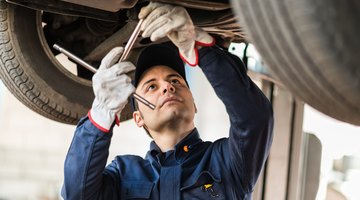


Vocational teachers, like auto mechanics instructors, play a valuable role in society. They provide students with the necessary training to carry on careers in their chosen field of study. Auto mechanics instructors prepare students for work in the field or simply prepare them to work on their own vehicles. Requirements to teach auto mechanics vary by state, vocational institution and the level of education students receive (secondary or post-secondary).
Secondary Education Requirements
Many high schools nationwide have vocational training programs or work with vocational schools located close to the high school that allow students to take courses in fields like auto mechanics. The U.S. Bureau of Labor Statistics (BLS) notes that licensing is required to teach in all 50 states as well as in the District of Columbia. Teachers can follow many paths to licensing. In all cases, however, a bachelor's degree is required to receive a license. The traditional route is to go through an approved teacher training program that involves supervised student teaching. A degree in industrial technology is the most likely path for the auto mechanics teacher, but it is possible to receive a degree in another field and be licensed if the student has received adequate vocational training in the field. Some states will allow teachers to receive alternative certification in this way also. Some teachers will obtain a bachelor's degree in an unrelated field and then demonstrate their experience and knowledge through testing.
Vocational School Education Requirements
The educational standards for teaching in a vocational school are similar to those a college instructor would need to teach. The primary difference is that vocational teachers usually need a minimum of a bachelor's degree in their field of expertise, while college instructors need a master's degree. Vocational school teachers must be licensed as secondary education teachers, however, if they will be teaching secondary and post-secondary education students. Some schools will require a minimum number of years of experience working in the field or possibly the completion of a teacher training program in the auto mechanics field, but this will vary by state and institution.
Certification Requirements
A perusal of several job openings on various internet job boards reveals that some schools may require additional certifications for employment. For instance, the National Institute for Automotive Service Excellence provides certification (ASE) for auto mechanics who have met standards of excellence in automotive repair training. Some schools require teachers to obtain ASE certification prior to employment. Other schools require students to obtain the clear designated subjects vocational education teaching credential or the career technical education in automotives credential.
Related Articles







References
Writer Bio
Jared Lewis is a professor of history, philosophy and the humanities. He has taught various courses in these fields since 2001. A former licensed financial adviser, he now works as a writer and has published numerous articles on education and business. He holds a bachelor's degree in history, a master's degree in theology and has completed doctoral work in American history.