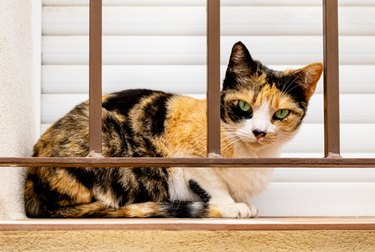
The calico cat has a tri-color pattern of white, orange, and black on its coat. This type of coat coloring does not indicate a specific breed of cat, just a color pattern, available in different breeds. But calico cats are almost always female, and because of the variation in size between breeds, the average weight of a female calico cat can also vary. It usually ranges between 7 and 12 pounds, although some can weight as much as 25 pounds.
Video of the Day
Identifying calico cats
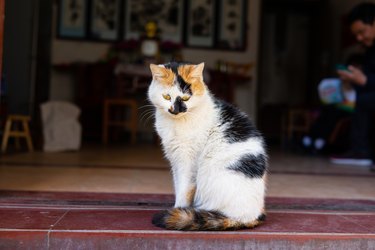
A calico cat's coat contains a majority of white fur with patches of black and orange tabby, also called red tabby, fur mixed in. The orange patches have typical tabby lines or dots. Calico cats come in short, medium, and long-haired breeds, which vary in size.
Video of the Day
The Cat Fanciers' Association currently recognizes 16 breeds of cat that can result in the calico color pattern. A cat with a majority of white fur, along with blue and cream patches on her coat is called a dilute calico and comes in various breeds of cat, similar to the traditional calico. Because of the genetics of the coloring, most calico kittens of any breed are female.
Calico cat breeds and weight
A female calico's cat's average healthy weight varies by the breed of the cat. The average weight of a female Maine coon calico cat, one of the largest cat breeds, varies between 9 and 12 pounds, while the diminutive, short-legged munchkin cat weighs between 4 and 8 pounds. The Scottish fold, with its unique, folded-down ears, weighs between 6 and 9 pounds.
The Manx, a tailless breed of cat weighs between 7 and 11 pounds, as does the long-haired Persian. The British shorthair female calico weighs between 9 and 15 pounds, while the American shorthair weighs between 8 and 12 pounds.
Calico kittens and adult sizes
The age of a female calico also determines its average weight. An adult cat weighs between 7 and 9 pounds, but a younger cat will weigh significantly less. At birth, a kitten weighs 3 ounces, and gains one-half an ounce each day and reaches 2 pounds at 10 weeks of age. A kitten will grow to her full adult size between 8 and 12 months old. During this period of growth, a kitten will average between 3 and 7 pounds, and requires a greater amount of food each day than she will when she reaches adulthood.
Weight issues in cats
Though the average healthy weight of a calico cat varies, some of these cats might have obesity issues, which affect their size. To determine if a calico cat is overweight, feel her body and ribs. You cannot feel an obese cat's ribs because of the high amount of fat on her body, while a malnourished cat's ribs have little to no fat on them.
Viewed from above, an obese cat has a round shape, with no defined waist below the ribs. A cat of a healthy weight has a slight tuck indicating a waistline. Though the average, normal-sized calico cat weighs between 7 and 9 pounds, an obese one can weigh significantly more and requires feeding with a commercial weight reduction diet. Like people, overweight cats are at greater risk of developing health problems such as diabetes, high blood pressure, arthritis, heart disease, and some forms of cancer.
Feeding for a healthy weight

Knowing the healthy weight of your calico cat is important because that determines how much food they should be fed to maintain that weight. An adult cat, for instance, should eat about 1 ounce of canned food, or one half ounce of dry food, per pound of body weight per day. Note the weight measurement used should be based on a healthy weight, not necessarily the current weight if the cat is on the chubby side.