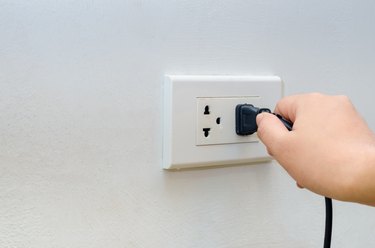
You've heard of AC and DC current, but if you got asked about the significance of the initials in a Jeopardy game, would you be able to answer? Many people use the terms without understanding what the DC and the AC abbreviations stand for. The terms "AC" and "DC" refer to the type of electric current used by a device. Batteries and many power supplies produce DC, while the electricity in your wall outlets is AC.
AC Abbreviation/DC Abbreviation
Video of the Day
The term "AC" stands for alternating current. The polarity of the electric charge switches from positive to negative, or alternates, at a fixed rate. What does that mean? It means that electrons in the charge first flow in one direction, then the other, switching back and forth at regular intervals or cycles. For typical household current in the United States, AC current alternates at 60 cycles per second. However, in Europe and most of the rest of the world, it alternates at 50 cycles per second.
Video of the Day
The abbreviation "DC" stands for direct current. The polarity of the electric charge does not switch back and forth. This is why one end of a battery is positive, and the other end is negative. Current flows from the negative end of the battery, through the device being operated and back to the battery at the positive end.
Differences in AC and DC Current
Now that you know the AC meaning and the DC meanings, you may want to know the differences between the two. Devices designed to operate on AC current can use more energy because AC can be easily transmitted at high current levels (amperage). A typical home has a 200-amp electrical system. At the typical voltage of 120 volts, this permits consumption of up to 24,000 watts, more than enough for the many devices we use every day. Most batteries permit only a tiny fraction of this consumption, typically allowing loads in the milliampere range, or 200,000 times less than a home load center.
Devices designed to operate on DC current use batteries or a power supply device that converts household AC to DC at the correct voltage. The main advantage of DC is the device can be portable, operating off batteries rather than having to be plugged into a wall outlet.
Fun AC/DC Fact
Inventor Thomas Edison wanted to use DC power for the country's first electrical grid system. However, the high cost to transmit DC over long distances led utility companies to reject Edison's plan in favor of the cheaper AC system we have today.