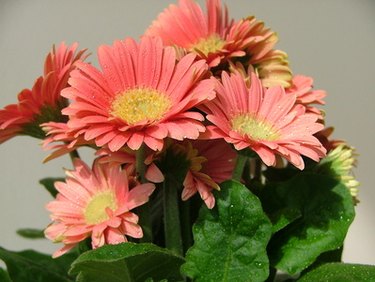
A member of the aster family, the Gerbera (Gerbera jamesonii) is a daisy-like, herbaceous perennial. The gerbera flower is named in honor of Traug Gerber, a German naturalist, and Robert Jameson, two of the discoverers of the species. Native to Transvaal, South Africa, the gerbera is also known as the Transvaal daisy. Relatives include the daisy, sunflower, endive and lettuce. The gerbera daisy, as it is also known, was imported into Europe from South Africa in the nineteenth century.
Description
Video of the Day
Gerberas possess open, flat flowers with widths of about 2 to 7 inches and range in color from orange, red, pink, white and yellow to bi-colored blooms. The eye of the gerbera flower can be red, brown, green or black. This fragrance-free flower turns its head to follow the sun. There are five distinct flower forms based upon the number of petal rows and their overlap patterns. These five forms are named single, double, crested double, full crested double and quilled crested double. Gerbera stems are 24 to 36 inches long, leafless and can be hollow. Cold-tolerant to 30 F, but sensitive to frost, the gerbera daisy is used in flowerbeds and for cut flower arrangements.
Video of the Day
Starting Gerbera Plants
With over 300 varieties, gerberas are grown in a wide range of colors. The least costly way to grow the gerbera daisy is from a seed. To plant the seeds, make shallow rows, about twice the depth of the seed diameter, in the garden's soil; sow the seeds, cover them lightly with additional soil and water them well.
Growing a Gerbera Daisy Plant
Gerbera flowers grow best in well-drained, nutrient-rich soil. Gerberas will grow in full sun but prefer a growing area with morning sun and afternoon shade. To avoid disease, remove spent blooms and old leaves regularly. The gerbera daisy can be dug up and its crown divided to thin the plant if it runs out of space or as new plants are required.
Pests
Insects can damage Gerbera flowers. Leaf miner insects, whose larvae feed on the leaf tissue, produce tunnels that look like squiggly lines. Caterpillars and cutworms may attack the plants and leave behind ragged leaves or injured stems. Spider mites and thrips feed on plant juices. Thrips dine on flowers and leaves; spider mites prefer to damage new growth first before moving on to older tissue.
Diseases
Fungal diseases, such as gray mold, can infect gerbera daisies. This disease is caused by Botrytis cinerea; this fungus attacks dead plant parts first and then spreads to living tissue. Powdery mildew disease occurs during times of high humidity and cloudy weather. Spreading quickly, small patches of white mildew form on flowers and leaves. Afflicted parts soon dry up and die.