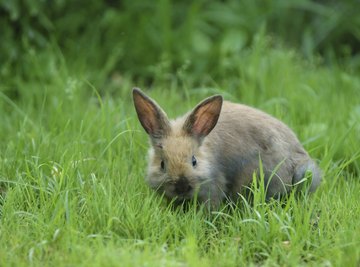
There are 29 rabbit species in the Leporidae family found around the globe. While we typically think of adorable rabbits grazing in meadows, some species of rabbits live in deserts, while others live in wetlands and tropical forests. The rabbit life cycle fits into an r-selected model of reproduction. The r/K selection theory states that r-selected animals focus more energy on having plentiful offspring while K-selected animals put more investment into producing very few offspring but with a lot of parental care, like humans.
Where Do Rabbits Live?
Most rabbits, except cottontails, rely on warrens for shelter and protection from predators. Warrens consist of a network of burrows underneath the ground. The complexity of a warren depends on the soil structure and how high the water table is. Most rabbits live solitary lives or in pairs, but up to 30 rabbits may share a warren.
What Do Rabbits Eat?
Rabbits are herbivorous, primarily eating grasses and other plants for their nutrition. To get all the nutrients they need, rabbits must eat large quantities of food. Rabbits use a behavior called coprophagy to help them meet their nutritional requirements. Coprophagy is when an animal eats its own feces. This action allows the digestive system a second attempt at extracting the most-needed nutrients from the difficult to digest plant matter.
Rabbit Lifespan
Rabbits typically live up to three years in the wild. The majority of rabbit offspring don't survive past three months of age. In the wild, rabbits are common prey for larger predators such as wolves, foxes, cats and stoats. Juvenile rabbits are also vulnerable to smaller predators such as badgers, birds of prey and weasels. Well cared for rabbits in captivity tend to live between eight and 12 years.
Rabbit Courtship
Rabbits court using soft honking-type sounds. Rabbits may also hop around each other in circles. The rabbits may be seen jumping over each other or one may jump while the other runs under. Domestic rabbits are known to use this circling behavior to get the attention of humans.
Rabbit Breeding
A female rabbit is called a doe. A male rabbit is called a buck. Like cats, baby rabbits are called kittens or kits for short. A doe starts to become sexually mature at around three and a half months of age while bucks are a little bit older at four months. Rabbits usually breed in spring and summer when temperatures are higher and resources more abundant.
The doe's estrus cycle is very short compared to humans, varying between three and 12 days. Copulation stimulates ovulation. Pregnancy is around 31 days but varies between species. Female rabbits can get pregnant immediately after giving birth.
Rabbit Birth
A doe typically has between three and seven kits per litter. Over her lifetime, a doe can produce up to one litter per month during the breeding season. The doe births her kits in a grass- and fur-lined nest, safely inside her burrow.
Kits are altricial, meaning they are entirely reliant on their mothers' care. When they are born, kits are hairless, blind and deaf. Despite their altricial beginnings, kits develop quickly. In the wild, the buck doesn't help with caring for the kits.
Rabbit Growth Stages
Kits open their eyes around 10 days old. The doe usually forages during the day and feeds her kits at night. At around 18 days old kits start to venture out from the burrow and nibble on wild vegetation. Kits are weaned off their mother's milk between 21 and 25 days. Once kits are weaned, they stay around the family burrow until they are four to five weeks old before venturing out into the wide world.
References
- Northern Arizona University: R and K Selection
- Blue Cross: How Long Do Rabbits Live?
- North Dakota State University: Rabbit Terminology
- Nihon Chikusan Gakkaiho: The Oestrous Cycle and Ovulation in the Rabbit
- FAO: The Rabbit
- Encyclopaedia Britannica: Rabbit
- New England Cottontail: Breeding and Lifespan
- San Diego House Rabbit Society: General Rabbit Care Behavior
About the Author
Adrianne Elizabeth is a freelance writer and editor. She has a Bachelor of Science in Ecology and Biodiversity, and Marine Biology from Victoria University of Wellington in New Zealand. Driven by her love and fascination with all animals behavior and care, she also gained a Certificate in Captive Wild Animal Management from UNITEC in Auckland, New Zealand, with work experience at Wellington Zoo. Before becoming a freelance writer, Adrianne worked for many years as a Marine Aquaculture Research Technician with Plant & Food Research in New Zealand. Now Adrianne's freelance writing career focuses on helping people achieve happier, healthier lives by using scientifically proven health and wellness techniques. Adrianne is also focused on helping people better understand ecosystem functions, their importance, and how we can each help to look after them.
Photo Credits
Hemera Technologies/Photos.com/Getty Images