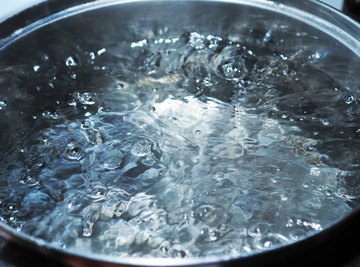
The pH scale measures how acidic or alkaline something is. Pure or distilled water, a neutral substance, has a pH of 7. However, if you increase the temperature of the water, its pH level decreases. However, the change is so slight you are unlikely to detect it with pH testing strips.
TL;DR (Too Long; Didn't Read)
The pH level of pure water drops as temperature increases and rises as temperature decreases, although these changes are too small to be picked up by basic pH testing methods.
The pH Scale
You may be used to thinking about the pH scale simply in terms of how acidic or alkaline a solution is; a pH less than 7 means acidic and a pH greater than 7 means alkaline. But it is also a measure of the hydrogen ion concentration of a solution. A solution with a higher concentration of hydrogen ions has a lower pH than one with a lower concentration of hydrogen ions. A difference of one pH (i.e., from pH 5 to pH 6) is a ten-fold difference in hydrogen ion concentration.
Le Châtelier's Principle
Le Châtelier's principle is a key concept of chemical equilibria. According to this principle, when you change one of the factors that represent a system at equilibrium, the position of equilibrium shifts to counter that change. One way to change the conditions of a chemical reaction is to change temperature. If you apply this to the temperature of water and its pH level, increasing the temperature of water prompts the equilibrium to lower the temperature again, which involves absorbing additional heat. This creates more hydrogen ions and hydroxide ions, which in return lower the pH of the water. An increase in temperature from 0 degrees Celsius to 10 degrees Celsius results in a 0.2 drop in pH. If you decrease the temperature the opposite will happen: the pH level will increase very slightly.
Difference Between pH and Acidity
A drop in the pH of water does not mean water becomes more acidic at higher temperatures. A solution can only become more acidic if there is a higher level of hydrogen ions than hydroxide ions. In the case of pure water, the concentration of hydrogen ions and hydroxide ions never changes, so water is always neutral regardless of whether its pH level changes. At room temperature (25 degrees Celsius) the pH of pure water is 7. If you increase the temperature to 100 degrees Celsius, the pH of pure water is 6.14, which is still neutral on the pH scale even though it is lower than 7.
References
About the Author
Claire is a writer and editor with 18 years' experience. She writes about science and health for a range of digital publications, including Reader's Digest, HealthCentral, Vice and Zocdoc.