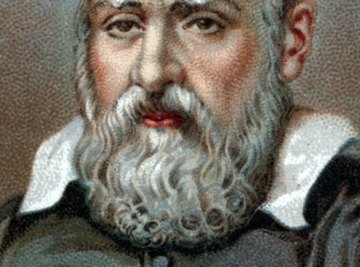

Kids with an interest in astronomy will want to learn about Galileo Galilei, whose work was dynamic and even shocking to some people in the 16th century. Galileo is considered important because he helped the world see the solar system differently, and came up ideas and inventions still used in the 21st century.
Early Life
Galileo Galilei was born in 1564 in Italy. He was initially educated in a monastery, where he was given his schooling by monks of the Camaldolese Order. After this, Galileo decided he wanted to be a monk himself. His father had other ideas, and to please his father, Galileo entered the University of Pisa to study medicine in 1581. He never finished this degree though, and later took up the study of math.
Telescopes
Galileo was fascinated by the idea of the telescope, and used the designs created by other people to build his own. This telescope was better than the devices other scientists had made, and by the end of his life, Galileo had created a telescope that allowed the user to magnify objects at 30 times their original size. With his telescope, Galileo discovered Callisto, Europa, Ganymede and Io: better known as the moons of the planet Jupiter.
Other Discoveries
Galileo wasn’t satisfied with just discovering moons of other planets. He also used his telescope to look at the moon that orbits Earth and was excited to find that the moon had craters and mountains, just like Earth. Galileo also did research into gravity and speed. He threw balls, one heavy and one light, off the famous Leaning Tower of Pisa and observed the way each hit the ground. Both balls hit the ground together and this science experiment told Galileo that objects fall at the same speed regardless of weight.
Controversies
The trouble with some of Galileo’s ideas was that they went against what many people believed at the time. In Galileo’s era, most scientists thought that the Earth sat at the center of the universe with every other planet spinning around it. Galileo and a few other scientists such as Nicolaus Copernicus argued that the sun was at the center, not the Earth; astronomers call this idea the heliocentric model. Galileo argued with other scientists, and especially the powerful Catholic Church, which wanted to put Galileo in prison because of his strange ideas. Eventually, Galileo was made to say that his ideas were wrong to escape a harsh punishment.
References
About the Author
Simon Fuller has been a freelance writer since 2008. His work has appeared in "Record Collector," "OPEN" and the online publication, brand-e. Fuller has a Bachelor of Arts in English literature from the University of Reading and a postgraduate diploma from the London School of Journalism.
Photo Credits
Photos.com/Photos.com/Getty Images