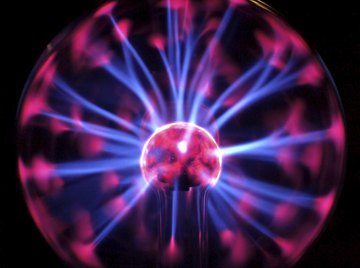
The most common form of matter in the universe, plasma is defined by the Southwest Research Institute as "a hot ionized gas containing roughly equal quantities of positively charged ions and negatively charged electrons," and is considered a fourth state of matter distinct from solid, liquid, or gaseous matter. A plasma ball is essentially a miniature Tesla coil channeling an alternating voltage of about 2-5 kilovolts at a frequency of about 30 Hertz, enclosed within a glass ball containing an inert gas such as neon or argon.
Basic Operation
The plasma ball operates when voltage is introduced in the miniature Tesla coil, creating an electric field inside the ball. As the electrode is negatively charged, the escaping electrons are introduced into the larger glass ball, where they interact with positively charged ions floating around inside. A concurrent oscillating voltage is introduced, changing the electric field and the path of the electrons, resulting in the tentacles – which, at this point, are invisible - that strike the inside of the larger glass ball.
Colorful Gas
The inert gas inside the larger glass ball serves to provide the escaping electrons with an ionizing charge and path for other electrons to follow. This creates the tentacle that continuously extends from the Tesla coil to the larger gas ball for as long as voltage is supplied. During this process, the inert gas atoms are excited and shed electrons, resulting in colorful light. The color of the light depends on the type of inert gas introduced into the ball, which is usually neon but other options include:
- helium
- argon
- krypton
- xenon
- various mixtures
References
About the Author
Jonathan Marker is an aerospace analyst and graduate of Embry Riddle Aeronautical University. A current MA candidate in military studies at American Military University, he has written hundreds of articles on a wide range of general science, aviation and history topics. Marker is currently working on several science fiction projects.
Photo Credits
Sini?a Bota?/iStock/Getty Images