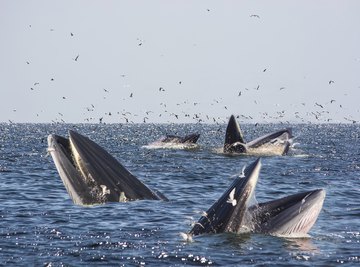

What do whales eat? The answer isn't quite as simple as you might think! A whale's diet depends heavily upon not only the species of whale, but also the type of whale. Some species feed primarily on fish, while others sustain themselves almost exclusively on krill and other tiny crustaceans.
The Two Groups of Whales
Researchers divide all living whales into two primary suborders – Mysticeti, the baleen whales, and Odontoceti, the toothed whales. The baleen whales differ vastly from the toothed whales in their feeding habits and their basic anatomy. In most cases, baleen whales grow much larger than toothed whales. They also lack teeth, growing sheets of baleen instead, a hair-like substance composed of keratin.
Mysticeti: The Baleen Whales
The baleen plates of this group of whales work like large colanders. The whale takes in a large mouthful of seawater and then pushes the water out through the baleen, leaving a mouthful of prey behind. Though 11 different species of baleen whales exist today, nearly all of them feed on the same types of food.
Krill are the primary prey of most baleen whales. Krill live in swarms, and the whales consume them by the thousands in massive mouthfuls. These tiny crustaceans, known as zooplankton, measure just two inches long on average but sustain the largest animal on Earth. The blue whale, the largest animal alive on this planet, survives almost exclusively on krill.
Odontoceti: The Toothed Whales
The members of Odontoceti, which include dolphins and porpoises, lack baleen and instead feature a row of sharp, conical teeth perfect for catching fish. When it comes to whale food, fish reign supreme among toothed whales. There are more than 76 toothed whale species, and the majority feed on some type of fish. However, the type that they prey on varies from one whale to the next.
Different whale species, and even whales of the same species in different geographic regions, feed on different fish species. For example, common bottlenose dolphins who live in coastal regions feed more frequently on bottom-dwelling invertebrates than their offshore counterparts. Conversely, offshore dolphins feed more frequently on deep-sea fishes and squid than coastal populations.
Sperm Whale Diet
The sperm whale diet differs slightly from other toothed whale species. While they do feed on fish, this species specializes in one particular – and notorious – type of prey. When you think of the best whale food, you likely don't think of giant squid, but sperm whales sure do!
In fact, adult sperm whales bear the telltale round scars left by the suckers of their massive deep-sea prey. A single sperm whale typically eats 3 percent of its body weight in squid in a single day. As these whales can easily surpass 10,000 pounds, that means they can consume upwards of 300 pounds of squid per day!
Killer Whale Diet
A killer whale's diet varies based on the population at hand. Some groups of killer whales, also known as pods, remain in the same general area. Researchers classify these pods as resident killer whales because they do not range long distances. Resident killer whale populations usually feed primarily upon fish and squid, like other toothed whales.
However, pods of killer whales that range throughout vast expanses of the ocean, known as transient killer whales, prefer different types of prey. Transient killer whales feed primarily on other marine mammals. Seals and sea lions often fall prey to these transient whales, as well as dolphins and even the calves of larger whale species such as gray whales.
Transient killer whales work together to hunt larger prey. Some pods also use unique hunting techniques, such as washing seals off of ice flows by working together to create waves. Several pod members rush the ice from one end, while another pod member waits at the other end to capture the seal once they've washed it off the ice.
References
- SeaWorld Parks & Entertainment: All About Baleen Whales - Scientific Classification
- Convention on Migratory Species: Odontocetes: The Toothed Whales
- Animal Diversity Web: Blue Whale
- Animal Diversity Web: Sperm Whale
- Animal Diversity Web: Killer Whale
- National Geographic: Krill
- SeaWorld Parks & Entertainment: All About Bottlenose Dolphins
- Nature: Unique Orca Hunting Technique Documented
About the Author
Marina Somma is a freelance writer and animal trainer. She holds a B.A. in Psychology and a B.S. in Marine and Environmental Biology & Policy from Monmouth University. Marina has worked with a number of publications involving animal science, behavior and training, including animals.net, SmallDogsAcademy and more.