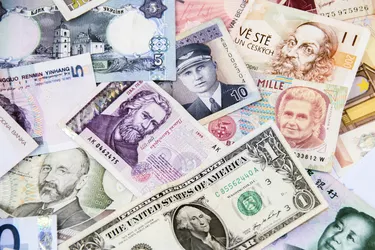
The values of major currencies such as the U.S. dollar, euro and Japanese yen change because of economic conditions as well as supply and demand forces. Two kinds of markets exist to facilitate currency trading, allowing you to make money on exchange rates if you can forecast the value changes of currencies relative to each other.
Small Changes, Big Bucks
Video of the Day
Exchange rates change in very small increments under most economic conditions. Daily moves are often measured in 1/100ths of a cent, called a pip or a tick depending on the market. Traders use leverage to turn small rate changes into larger profits or losses. For example, U.S. securities law allows up to 50-1 leverage when trading spot currency values. This means you can control $100,000 worth of currency with a $2,000 investment. At this level, a half-cent change in the exchange rate -- 50 ticks -- is worth a $500 profit.
Video of the Day
Spot or Futures
Currency trading can be done in the spot market or on the futures exchanges. Spot trading -- often called forex, short for foreign exchange -- is done through independent brokers who work with other brokers and banks to set rates. There is no formal spot currency exchange, and it doesn't cost a lot to get started. Spot trading can be initiated with a very small account of $100 or less if you want to just dip a toe in the trading pool. Trading currency futures, on the other hand, requires an account with a commodity futures broker and it can take several thousand dollars to open one. Transaction costs are generally lower in futures trading and contracts are listed on a regulated exchange.
Long-Term Strategy
Fundamental analysis uses economic factors to determine the probable direction of exchange rates. Traders compare conditions and interest rates in different countries to predict how currencies are likely to change in value against each other. Traders employ fundamental analysis strategies in hopes of profiting from longer-term positions after trying to understand where currency rates will be months or even years ahead of time.
Short-Term Indicators
Technical analysis is typically used with day trading for holding periods measured in minutes or hours and swing trading with time frames counted in days. It uses recent price action to predict trends or price reversals. The trading industry has developed a wide range of charting tools to help see and predict currency rate action. A broker's trading software includes technical analysis indicators that can be overlaid onto currency price charts. Technical analysis can be combined with fundamental factors to produce hybrid trading signals.