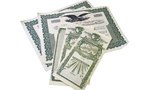
Why Do People Buy Stock?

People buy stock to make a profit and build wealth. You may buy stock to provide for your retirement or college tuition expenses. Because of their risk vs. reward profiles, stocks are best for long-term investing.

  1. Identification

    • At its initial public offering, or IPO, a corporation sells shares of stock to raise cash through equity financing. In exchange, investors receive business ownership stakes. After the IPO, shares trade hands directly between investors in what is referred to as the secondary market.

      Shares of stock shift in value alongside business profits. Theoretically, share prices may approach infinity because business profits are unlimited. At worst, your investment would collapse to zero amid corporate bankruptcy.

    Features

    • As a benchmark for U.S. stock market, the S&P 500 Index, has averaged 11 percent annual returns since its creation in 1957. Historical returns for stocks far exceed what is available on competing bonds and money market deposit accounts. The 11 percent average return statistic, however, includes a 38 percent gain in 1995 amid a technology boom and a 37 percent decline in 2008 during a housing and credit crisis. To effectively manage this volatility it is best that you take a long-term investment approach.

      Instead of immediately committing one lump sum of cash to buy stocks, you may dollar-cost-average smaller amounts into the stock market over time. Long-term investing allows you to take advantage of compound returns. A $250 monthly investment making a 10 percent annual return grows to $569,831 over 30 years.

    Considerations

    • Institutional investors sometimes purchase shares of common stock for control purposes. To do so, you would buy more than 50 percent of a corporation's outstanding common stock because one share of stock equals one vote. With this voting power, you may name your own board of directors and hire a new management team. Further, you could make an offer to buy all of the corporation's outstanding common stock and take the business back private. Buyouts work best when a business is not performing up to its potential. For example, you may purchase a chain retailer, close losing locations and sell off real estate for large profits.

    Warning

    • Stock market investment principal is never guaranteed. Stocks are especially volatile amid economic recession, when business profits decline sharply. Again, share prices fall toward zero amid business bankruptcy. Beyond individual stocks, systematic risk is always a concern for the overall market. Systematic risk is associated with financial system collapse and stock market crashes. Stocks usually crash when economic bubbles burst. In a bubble, asset prices far exceed business reality.

    Strategy

    • A diversified asset allocation can manage financial risks. Effective financial diversification allows you to make money during separate economic scenarios. For example, your diversified portfolio may include stock, bond and money market investments. In a recession, the bond and money market securities make interest payments and provide quick access to cash. Going forward, your stocks will generate strong returns when the economy recovers and grows.

Related Searches:

References

Resources

Comments

You May Also Like

  • Why Do People Invest in the Stock Market?

    People invest in the stock market because the average annual growth of companies in the S&P 500 is 8 percent. Earn money...

  • How Do People Buy & Sell Stocks?

    Selecting a method to trade stocks can depend on the confidence of the investor, as well as investment opportunities. Investors can choose...

  • Why Do Companies Buy Back Their Own Stock Shares?

    When a company makes a large stock offering to the public, it tends to make the news. However, when the same company...

  • Why Do People Buy Shares?

    There are many reasons why someone might choose to purchase shares of stock in a company, but the ultimate goal of any...

  • Why People Should Invest in Stocks

    There's only one basic reason people invest in stocks: to make money. Whether you're curious about the market for your own financial...

  • Why Do Investors Buy Mutual Funds & Stocks?

    There are a wide variety of products available to investors, ranging from conservative, low-risk investments such as United States government-issued bonds to...

  • Why Do Investors Buy Stocks?

    Stocks are units of ownership in a corporation. If you bought 1,000 shares of a company that has 5,000 shares, you would...

  • Why Do Stocks Exist?

    Stocks refer to units of partial ownership of publicly traded companies, bought and sold between individuals and/or groups of investors on stock...

  • Why Buy Treasury Stock?

    After a company issues stock, the stock starts trading on the open market. At times companies need to purchase their own stock...

  • How to Exceed Dollar-Cost Averaging Returns

    One of an investor's greatest nightmares is buying a stock position and then watching the market decline, day after day, leaving him...

Related Ads

Featured