
Railroad conductors coordinate all crew member duties. On freight trains, they supervise the loading of cargo and distribution of freight on the cars, along with unloading of cargo at various destinations. On passenger trains, conductors ensure passengers follow safety procedures, and they collect tickets, make announcements and answer questions. Most railroad conductors earn at least $40,000 per year, as of 2009.
Average Salary
Video of the Day

The U.S. Bureau of Labor Statistics includes railroad conductors and yardmasters in its salary figures for this occupation. About 41,540 of these workers were employed in the United States in 2009, earning an average salary of $26.39 per hour, or $54,900 per year.
Video of the Day
Salary Range

The middle 50 percent of railroad conductors were earning $19.36 to $31.88 per hour in 2009, or $40,260 to $66,300 per year. The bottom 10 percent had wages of $15.92 per hour and below, and the top 10 percent $39.05 per hour and higher, or $81,210 per year and more.
Highest Averages
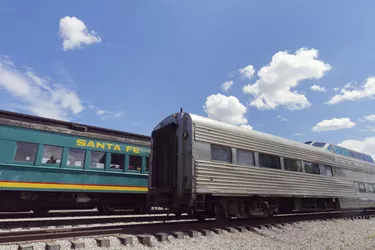
Railroad conductors were earning the most money on average in New Mexico, where their average salary was $34.33 per hour, or $71,410 per year. Rounding out the top five states for railroad conductor average salaries were Wisconsin at $69,520 per year, Mississippi at $68,810, Arizona at $67,520 and Oklahoma at $66,630.
Highest Top Pay

Railroad conductors in some states had higher salaries at the upper end of the pay scale than in states with the highest average pay. The top 10 percent of railroad conductors in Colorado received salaries at or above $102,100 per year and higher, in Oklahoma $99,080, in Nebraska $98,090, in Arizona $97,610 and in Kansas $97,420.
Outlook

Employment opportunities should be good for qualified applicants for railroad jobs from 2008 through 2018, according to the BLS. Railroad employment is likely to experience average growth as fuel prices increase, which makes rail transport less expensive than using trucks and cars. In addition, many railroad workers will probably retire during this time frame.