Dirty as it may be, much of the world's electricity is driven by burning coal. In 2019, the United States produced roughly 706 million tons of coal, all mined from the ground, loaded onto train cars, and shipped to power plants. But where does coal actually come from?
Coal in the United States
As far as fossil fuels go, coal is rather common. Many countries that use coal produce it domestically, but coal cannot be found everywhere. In the United States, 71% of coal is found in just five states.&text=The%20two%20largest%20coal%20mines,Black%20Thunder%20mines%20in%20Wyoming.). The state of Wyoming is the country's number one supplier, producing 39% of domestic coal. The other four states, in descending order, are West Virginia, Pennsylvania, Illinois and Kentucky.
These states all owe their coal production to geography. If state lines are dissolved, there are actually three distinct coal-producing regions in the United States. In the east, there is the Appalachian coal region, which lies along the Appalachian Mountains. The interior coal region stretches across the Midwest, and the western coal region lies along the Rocky Mountains.
How Coal Is Formed
During the Carboniferous period, around 300 million years ago, much of the Earth was covered by thick, marshy forests and shallow seas. Tons of plant life grew in wetlands, and these wetlands would flood often, burying mosses and algae underneath layers of mud. As this dead plant material became buried deeper and deeper, warm subterranean temperatures and high pressure compressed the organic material, while acidic water prevented oxygen from allowing the material to decompose quickly.
Areas today that trap carbon underwater are called peat bogs. Peat is a type of carbon-based fuel that can be burned, but it is not as energy-rich as coal. Coal is peat that has undergone a process called carbonization. Carbonization happens when heat and pressure compress carbon into dense, rocky coal.
In Which Layer of the Earth Is Coal Found?
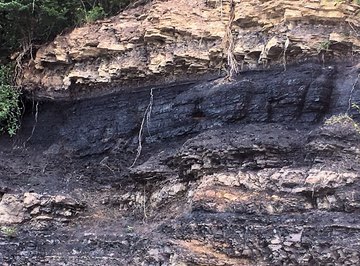
Coal is found as a layer of rock within the Earth's crust. Essentially, it is fossilized moss and algae, hence the name fossil fuel. Today, coal can be found in coal seams, which are layers of rock composed of coal. Coal seams are found on all continents, and they can range in thickness depending on the amount of carbon fossilized and the particular conditions under which it formed.
Coal seams are a geologic layer of rock, like any other. Imagine the Grand Canyon: do you recall its colored bands of rock? Those are geologic strata, and they look different because the rock layers were formed under differing atmospheric conditions, leading to slight differences between them. A coal seam would appear as a black layer among the rock strata.
Coal seams vary in both thickness and depth. Some coal seams in Wyoming, for example, are more than 100 feet thick, although most coal seams are much thinner than this. The deeper the layer is, the older and higher quality the coal in it tends to be.
Qualities of Coal
All coal is not equal. In fact, it is graded according to its carbon content. The lowest quality coal is called lignite. It has carbonized past the point of being peat, but it is regarded as being rather low grade as its carbon content, and thus its energy content, is only about 25% to 35%. These are often the youngest and shallowest coal deposits.
Bituminous coal is older and has a higher carbon content than lignite. It is divided into two grades, with the lower grade being sub-bituminous coal. Sub-bituminous coal is 35% to 45% carbon, and it makes up nearly half of the total coal mined in the United States. Bituminous coal is even more carbon-rich, and it is composed of as much as 80% carbon.
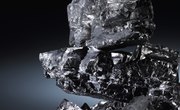
The highest grade of coal, anthracite, is composed of at least 97% carbon, and as a result it is really dense and has the fewest impurities.
References
About the Author
Cameron is a writer and educator based out of Fort Collins, Colorado. His work has appeared in New Scientist, LiveScience, Discovery's Curiosity Daily podcast, and MinuteEarth. He teaches Ecology and Evolution at the University of Northern Colorado.