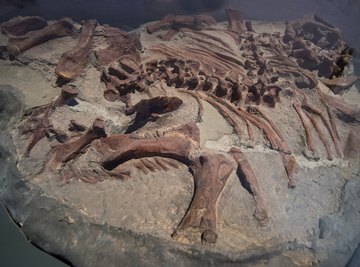
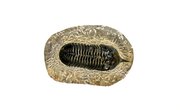
Fossils are traces of ancient life. For many people the word “fossil” probably conjures an image of a bit of hardened bone or shell, but fossils can take many forms. An imprint of a leaf, an insect preserved in amber or a footprint are all examples of different types of fossils. Scientists use fossils to gather information about the lives and evolutionary relationships of organisms, for understanding geological change and even for locating fossil fuel reserves.
The Facts
The oldest fossils on Earth are about 3.8 billion years old, or almost a billion years younger than the planet itself. Plants, animals and insects can all leave fossilized remains, but organisms that are completely soft-bodied, such as jellyfish, are less likely to leave fossils when they’re gone. Hard body parts like teeth, bone and shell are most likely to be preserved (reference 1).
Peeking into the Past
Fossil remains can give us insight into how prehistoric plants and animals obtained food, reproduced and even how they behaved. At times fossils can also provide evidence for how or why the fossil organism died.
Dating Layers of the Earth
Fossils aren’t used only to understand individual organisms. Geologists also use fossils for what’s called biostratigraphic correlation, which allows researchers to match layers of rock in different locations by age based on how similar the fossils in each rock layer are. This information can be used to help understand when different layers of rock were formed even when large distances separate them (reference 1).
Documenting Changes
Environmental interpretation, or understanding how the Earth has changed over time, is another area where fossils supply invaluable evidence. The type of fossil found in a particular location tells us what kind of environment existed when the fossil was formed. For example, if you find fossil marine animals like brachiopods in the sandstone in your backyard, you know that there must have once been an ocean where your house now stands (reference 1).
Fossils and Oil
Fossils also have practical and commercial applications. The oil used in our energy and plastics industries tends to collect in specific types of rock layers. Because fossils can be used to understand the age of different rock layers as described above, studying the fossils that surface when digging oil wells can help workers locate oil and gas reserves (reference 2).
And of course, coal, oil and gas are themselves called “fossil fuels” because they’re formed from the organic remains of prehistoric organisms.
Evolution
Perhaps one of the most important functions of fossils from a scientific perspective is that they constitute one line of evidence for understanding evolution. Using information pieced together from fossil evidence, scientists can reconstruct body types of animals that no longer exist and put together a “Tree of Life” to describe the evolutionary relationships between organisms (reference 3).
The Fossil Record
Fossilization is a relatively rare process. Most organisms are not preserved in the fossil record. Because soft-bodied organisms, for example, usually don’t form fossils, there can be “gaps” in the fossil record.
Many exceptional deposits of fossils nevertheless provide a surprisingly detailed glimpse into the past and allow scientists to piece together a more complete picture of the history of life on Earth (resource 2).
References
About the Author
Liz Veloz is a writer, scientist and college teacher living in Madison, Wis. Her science, travel and adventure writing has appeared in numerous literary journals and other publications. Veloz holds a doctorate in the biological sciences and a Master of Arts in English from the University of California, Davis.