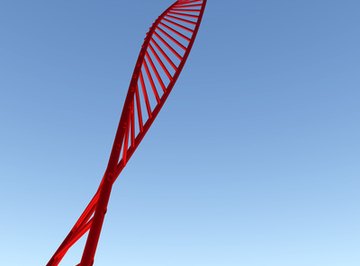

Histones are basic proteins found in the nuclei (singular: nucleus) of cells. These proteins help organize very long strands of DNA, the genetic "blueprint" of every living thing, into condensed structures that can fit into comparatively small spaces within the nucleus. Think of them as spools, which allow a great deal more thread to fit inside a small drawer than would be the case if long lengths of thread were simply wadded up and tossed inside the drawer.
Histones do not serve merely as scaffolding for DNA strands. They also take part in gene regulation by affecting when certain genes (that is, lengths of DNA associated with a single protein product) are "expressed," or activated to transcribe RNA and ultimately the protein product a given gene carries instructions for making. This is controlled by slightly altering the chemical structure of the histones via related processes called acetylation and deacetylation.
Histone Fundamentals
Histone proteins are bases, which implies that they carry a net positive charge. Since DNA is negatively charged, histone and DNA readily associate with each other, allowing the aforementioned "spooling" to occur. A single instance of many lengths of DNA being wrapped around a complex of eight histones forms what is called a nucleosome. Upon microscopic examination, successive nucleosomes on a chromatid (i.e., a chromosome strand) resemble beads on a string.
Acetylation of Histones
Histone acetylation is the addition of an acetyl group, a three-carbon molecule, to a lysine "residue" at one end of a histone molecule. Lysine is an amino acid, and the 20 or so amino acids are the building blocks of proteins. This is catalyzed by the enzyme histone acetyltransferase (HAT).
This process serves as a chemical "switch" that makes some of the nearby genes on the chromatid more likely to be transcribed into RNA while making others less likely to be transcribed. This means that DNA acetylation via histones alters gene function without actually changing any DNA base pairings, an effect referred to as epigenetic ("epi" means "upon"). This occurs because changes to the shape of the DNA expose more "docking sites" for regulatory proteins that, in effect, give orders to the genes.
Deacetylation of Histones
Histone deacetylase (HDAC) does the opposite of HAT; that is, it removes an acetyl group from a lysine portion of histone. Although these molecules in theory "compete" with each other, some large complexes have been identified that contain both HAT and HDAC portions, suggesting that a great deal of fine-tuning occurs at the level of DNA and the addition and subtraction of acetyl groups.
HAT and HDAC both play important roles in developmental processes in the human body, and failures of these enzymes to be properly regulated has been associated with the progression of a number of diseases, cancer among them.
References
About the Author
Kevin Beck holds a bachelor's degree in physics with minors in math and chemistry from the University of Vermont. Formerly with ScienceBlogs.com and the editor of "Run Strong," he has written for Runner's World, Men's Fitness, Competitor, and a variety of other publications. More about Kevin and links to his professional work can be found at www.kemibe.com.
Photo Credits
DNA 10 image by chrisharvey from Fotolia.com