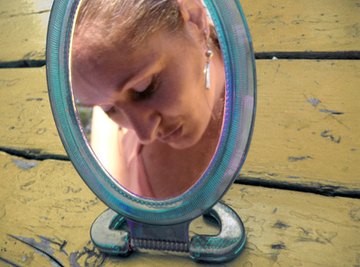

Light is often said to reflect off of mirrors and other smooth surfaces such as the surface of a lake. To understand how this works, you must first understand what light is. Then you can easily grasp why light seems to reflect off of mirrors better than other surfaces.
What is Light?
Light is simply a fast-moving type of energy. We often talk about light reflecting off of mirrors, but in reality light reflects off of everything. Look around the room you're sitting in. You may see chairs, other people, perhaps some paintings on the wall. Light is reflecting off of all these objects. When the reflected light gets to your eyes, your brain translates it into images that you recognize as the things around you.
How Light Translates into Images
To understand how mirrors work, you first must understand what happens when light hits an ordinary object. Light is made up of many rays, or beams, of energy. Ordinarily, many rays of light hit an object at the same time. Upon hitting the object, the rays of light are reflected in different directions. When the reflected rays hit our eyes, we see the object they are reflecting off of.
How Mirrors Work
A mirror is a surface that reflects light more perfectly than ordinary objects. Most objects reflect light at varying angles. This is more accurately called refraction, because the rays of light bend when they hit the object and move off in varying directions. This allows us to see the object they bounced off of.
When light rays hit a mirror, however, they are reflected perfectly. The reflected rays therefore meet at a point. This phenomenon, which is called convergence, causes us to see reflected images when the light rays hit our eyes.
Light and Flat Mirrors
When light hits a flat mirror, it is reflected to our eyes. It is also reflected to the rest of our bodies. It does not bounce perfectly off of our heads, eyes or other body parts facing the mirror. The rays that are refracted from our bodies then hit the mirror at varying angles and are reflected back perfectly. This phenomenon causes mirror images to appear backward to our eyes.
Light and Convex Mirrors
A convex mirror is curved outward. The fronts of most eyeglass lenses are convex.
Convex mirrors reflect light backward to a point behind the mirror. As a result, the image you see in the mirror is smaller than the object and appears further away than it is.
Concave Mirrors
Concave mirrors are curved inward. The backs of most eyeglass lenses are concave. This allows for greater correction of vision problems.
Concave mirrors draw light into their centers. When the light is reflected, it yields an image that is larger than the actual object.
References
About the Author
Jack Ori has been a writer since 2009. He has worked with clients in the legal, financial and nonprofit industries, as well as contributed self-help articles to various publications.
Photo Credits
mirror,mirror... image by Catabu from Fotolia.com