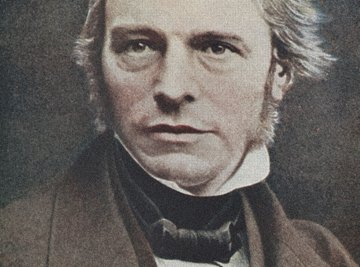

During his lifetime from 1791 to 1867, English inventor and chemist Michael Faraday made massive strides in the fields of electromagnetism and electrochemistry. Although he was also responsible for coining pivotal terms such as “electrode,” “cathode” and “ion,” Faraday's invention of the electric motor marks his most revered contribution to history, and its importance to the technological makeup of the world continues to this day.
Crystallizing Principles
In Michael Faraday's time, electricity was well known in the scientific community, but its place in the technological world was little more than a curiosity. By discovering and applying two key principles -- electromagnetic rotation and electromagnetic induction, in 1821 and 1831, respectively -- Faraday was able to apply electricity to a functioning electric motor in 1832. By generating electricity via moving a magnet across a wire coil, he powered the world's first electric motor, and later an electric generator and transformer of his making. Essentially, Faraday's invention of the electric motor, which converted electric current into mechanical energy, took existent ideas and theories about electricity and made them concrete, practical and useful.
Breaking Ground
Faraday's invention paved the way for other inventors to hone and perfect the electric motor. Led by Faraday's example, the Frenchman Hippolyte Pixii created the first device capable of outputting an alternating current via rotation. In1833, Heinrich Friedrich Emil Lenz developed the law of reciprocity regarding electric generators and motors. The next year, Moritz Hermann Jacobi combined this knowledge to create an electric motor that cleanly outclassed Faraday's invention in terms of both wattage and mechanical power. Further development of the concept continued at a similarly steady pace, until inventors in the early 1870s -- including Zenobe Theophil Gramme and Freidrich von Hefner-Alteneck -- created modern electric motors capable of producing consistently smooth-running direct currents, free of the ebbs that characterized early electric motors.
An Electric Revolution
By the 1880s, electric motors that refined Faraday's concept were producing energy on a large scale, with electric generators powering everything from industry to transportation to -- with the invention of the carbon filament lamp in the 1870s -- domestic lighting. Especially in America, the electric motor became a mighty force for industry; unlike Britain, which had an ingrained coal-gas infrastructure, the developing America was able to embrace electric power wholeheartedly. As such, the electric motor played a key role in a “Second Industrial Revolution” that lasted from about 1870 to 1914.Once electric motors became part of modern society, they never went away; today, devices as diverse as hand drills and disk drives employ electric small-scale motors.
Chemical Contributions
Not all of Michael Faraday's contributions to society were based on electricity. As an established chemist, Faraday discovered the carbon compound benzene, and in 1823, he was the first scientist to liquefy a gas. He also served as a chemistry professor at the Royal Institution, and often advised the English government on matters of science. Later in his life, he returned to electricity, developing the field theory of electromagnetism, a key component of modern physics, throughout the 1840s and 1850s.
References
- BBC: History: Michael Faraday (1791-1867)
- Karlsruhe Institute of Technology: The Invention of the Electric Motor 1800-1854
- The Open Door Website: Electricity and Electric Power
- Karlsruhe Institute of Technology: The Invention of the Electric Motor 1856-1893
- Northwestern University: The Second Industrial Revolution, 1870-1914
About the Author
Dan Ketchum has been a professional writer since 2003, with work appearing online and offline in Word Riot, Bazooka Magazine, Anemone Sidecar, Trails and more. Dan's diverse professional background spans from costume design and screenwriting to mixology, manual labor and video game industry publicity.
Photo Credits
Photos.com/Photos.com/Getty Images