Life Cycle of an Eagle

Life Cycle of an Eagle thumbnail
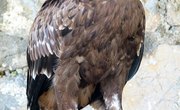
Magnificent golden eagle in its adult plumage.

There are more than 60 different kinds of eagles in the world with behaviors and habitats so varied that some may not even be of the same species. The life cycle of an eagle varies with its breed as well. The golden eagle, found in North America, Europe, North Africa and Asia, is the most widespread variety and a good one to consider when studying the life cycle of an eagle.

  1. The Egg

    • Eagle eggs can be tan or white with oatmeal colored spots.
      Eagle eggs can be tan or white with oatmeal colored spots.

      Eagles build their nests, or eyries, atop tall trees, high cliffs and bluffs. The female usually lays a clutch of two eggs, though she can lay as many as four. She incubates the eggs for about 40 days by sitting on the nest to keep them warm. Depending upon the climate, incubation can range from 30 to 50 days. Peter Nye, writing about bald eagles in The Journey North, says that males may incubate the eggs too. More commonly, the male takes part in this life cycle stage by catching small mammals to feed to the nesting female.

    Hatchlings

    • Eaglets that hatch first are bigger and compete better for food.
      Eaglets that hatch first are bigger and compete better for food.

      The newly hatched eaglet's survival depends on its place in the pecking order. After emerging from its egg covered in white fluff, the helpless hatchling is completely dependent upon its mother for food. It weighs about three ounces (85 grams). The first hatchling to emerge from its egg has an age and size advantage over the others in the nest. It grows stronger faster and can compete more successfully for food. Later hatching eaglets may starve if they are not feisty enough to compete.

    Fledglings

    • The young eagle may remain close to the nest for several months after learning to fly.
      The young eagle may remain close to the nest for several months after learning to fly.

      Before they "fledge" or leave the nest for the first time, young eagles remain as "nestlings" for 10 to 12 weeks. That is how long it takes for them to become fully feathered enough to fly and large enough to begin hunting for prey. The fledgling eaglet continues to return to the nest and stay around its parents for another month or more, learning how to hunt and refining its flying techniques. It may beg for food as long as the adult birds are willing to feed it. In all, it will be at least 120 days after birth before the young eagle is totally independent.

    Juvenile Stage

    • The young eagle may return to its birth nest for occasional visits.
      The young eagle may return to its birth nest for occasional visits.

      Even after it has left the nest, the juvenile eaglet faces survival challenges. The British Forestry Commission reports that between 60 and 70 percent of them do not survive the first winter. Once independent, juvenile eagles migrate to find a winter territory. Where prey is plentiful, they don't have to migrate at all, but they do have to disperse to find a big enough territory to support them. Expert Hope Rutledge, writing about golden eagles on her American Bald Eagle Information website, says adult golden eagles can roam a territory of up to 165 square miles. In four to five years, the juvenile will reach maturity. Until then, it may return to its birth nest from time to time.

    Maturity

    • Mature eagles usually mate for life.
      Mature eagles usually mate for life.

      When golden eagles reach sexual maturity, at between four and five years, they develop golden plumage on their heads and necks and reach a wing span of almost seven feet (two meters). Until then, it is possible to age the birds by their plumage. Eagles form mating pairs for life and build enormous nests up to 10 feet (three meters) in diameter, weighing up to 2,000 pounds (907 kilos). The adult pairs have no natural predators except man and can live up to 30 years.

Related Searches:

References

Resources

  • Photo Credit eagle eye image by michael luckett from Fotolia.com bird eggs in nest image by Matthew Cole from Fotolia.com love of birds image by timur1970 from Fotolia.com Teen Bald Eagle image by cullenphotos from Fotolia.com an eagle image by timur1970 from Fotolia.com Golden eagle image by MAXFX from Fotolia.com

Comments

You May Also Like

  • Life Cycle of the Golden Eagle

    The golden eagle (Aquila chrysaetos) is one of the largest birds of prey in North America. They also occur in Europe, Asia...

  • Life Cycles of Birds

    There are more than 9,000 species of birds that inhabit every region of the planet, from the burrowing owl of the American...

  • Common Wombat Life Cycle

    Wombats are cute, furry little marsupials that look more like rodents than kangaroos. Unfortunately, there is surprisingly little information on the animals,...

  • The Life Cycle of Houseflies

    The common housefly is an interesting insect. It has four stages of development, and in each stage, it looks completely different. The...

  • The Characteristics of an Eagle Bird

    The Characteristics of an Eagle Bird. The eagle is a large bird of prey belonging to the Accipitridae family. There are several...

  • About American Bald Eagles

    The American Bald Eagle is not only a beautiful, powerful, and majestic creature, this natural treasure is also the emblem of our...

  • The Life Cycle of Mammals

    Mammals life cycles can vary, especially in some varieties of mammals that may not be so obvious, such as dolphins and platypuses....

  • Life Cycle of a Dobsonfly

    Dobsonflies live in fast-moving, non-polluted streams and rivers throughout the world, except Europe. Most live in temperate climates, but parts of Asia...

  • Golden Eagle, Florida Breeding

    Bald eagles are a familiar sight in Florida. Once severely reduced in number, their populations have rebounded, and they may be encountered...

  • Why Is the Eagle the Symbol of America?

    After a long debate, congress chose the bald eagle to represent the United States in 1782. The eagle appears on the presidential...

  • Stages of the Human Life Cycle

    Human beings develop through periods of life that can be classified as stages. These stages are used by psychologists and scientists to...

  • Life Cycle of a Beaver

    Only two species of beavers exist. They can be found in the United States, Canada, Asia and Europe. Beavers live in streams,...

  • Bird Life Cycles

    Many birds migrate as a part of their life cycle, and most build a nest from sticks, mud or other material. Birds...

  • Apple Snail Life Cycle

    Apple snails are large freshwater snails. The apple snail is native to South America, Central America, and the southern United States. These...

  • How to See a Bald Eagle in Yellowstone National Park

    The bald eagle is, of course, the national symbol of the United States. It is a big and spectacular animal, distinguished by...

  • Body Parts of an Eagle

    Body Parts of an Eagle. For centuries, man has had a fascination with the eagle. The majestic birds have inspired people through...

  • What Are the Attributes of a Bald Eagle?

    What Are the Attributes of a Bald Eagle?. The bald eagle is a commanding figure with a cruel beak and piercing eyes...

  • Life Cycle of Dwarf Hamsters

    Four species of dwarf hamsters are available as pets--the Russian (also known as Campbell's), the Chinese, the Siberian (also known as winter...

  • Special Behavior in a Golden Eagle

    Golden eagles get their name from the golden-brown plumage on their heads. These majestic birds of prey live in North America, Asia,...

  • American Bald Eagle Gifts

    American Bald Eagle Gifts. The bald eagle, scientifically known as Haliaeetus leucocephalus, is the only eagle unique to North America. Bald eagles...

Related Ads

Featured