Bamboo is a group of plant species in the family Poaceae. These large, treelike grasses have hollow stems and small blade-like leaves. The hardy plant is highly adaptive and can grow in a variety of climates, from tropical to temperate—some types of bamboo even can survive in subzero temperatures. The popular bamboo plant grows throughout the world, and is used as food, construction material for fences and gates, and to make furniture and decorative items. It can also be a useful ornamental plant, both for container gardening and in the landscape, provided the conditions are right.
In ideal conditions, some bamboos are among the fastest-growing plants on the planet, with certain species that grow as much as 3 feet in a single day. Gardeners, therefore, need to take care that the plants do not become invasive in the garden and spread rampantly to where they are not wanted. In some climates, bamboo planted outdoors is kept within its boundaries by sinking metal plates into the ground to prevent the roots from spreading. The species known as "clumping" bamboos are easier to keep in check than those identified as "runners."
Video of the Day
Video of the Day
Bamboo is relatively easy to propagate simply by planting a "cutting"—a short length of stalk taken from an established plant. Unlike many plants, which must first have their cuttings rooted in water or starter soil, bamboo cuttings can immediately be planted in soil and will quickly root themselves.
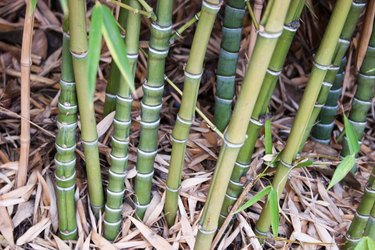
Step 1
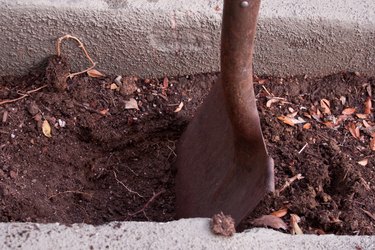
Dig holes with a shovel or sharp spade. The holes should be deep enough that half the internode—the hollow segment of the bamboo cutting that is between the nodes or joints—is above the ground.
Step 2
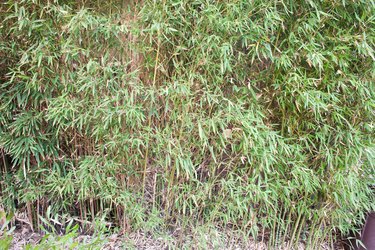
Select bamboo cuttings. Choose bamboo that is not more than 3 years old and has tall stems, preferably over 30 feet in height, so you can take several cuttings from a single stalk.
Step 3
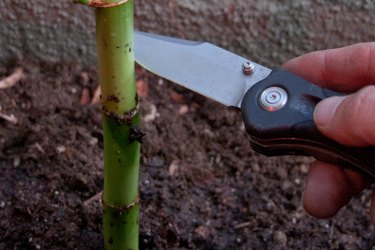
Use a knife or pruning shears to cut the bamboo. Take cuttings from the middle section of the stem. Each cutting should be long enough to include two full internodes plus one-half of an internode segment.
Step 4
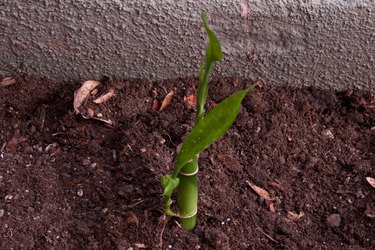
Plant the cuttings in the holes so that they each have one-half of an internode segment above the ground. Pack some clay around the cut edges of the top part of the bamboo to seal and to keep it disinfected.
Step 5
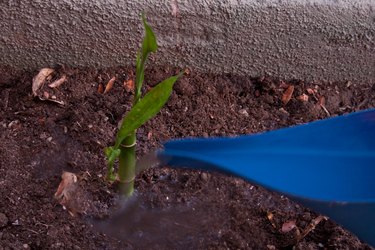
Pour 2 cups of water on top of each bamboo cutting. Keep the new stalks watered regularly until the cuttings develop roots and leaf shoots at the nodes.