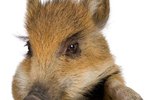
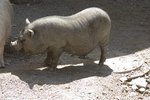
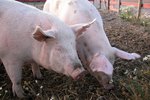
The wild pigs of the Americas are actually feral pigs, imported by humans. The only native wild species are the peccaries, which are distant relatives and not part of the pig (Suidae) family. While the pigs and peccaries share many characteristics, including sensitive, mobile snouts, there are distinct differences between the Old World and New World families.
Even-Toed Ungulates
Pigs, hogs and peccaries are all members of the order Artiodactyla, or the even-toed ungulates. Other members of the order include giraffes, hippopotamuses and musk deer. The eight genera of pigs and hogs, divided into 16 species, are all members of the Suidae family, while peccaries are members of the Tayassuidae family. Pigs and hogs are native to Europe, Asia and Africa. The Old World peccaries are extinct, leaving only the three species native to the Americas.
Range
The range of the collared peccary (Pecari tajacu), also known as Mexico musk hog and javelina, extends from southwestern North America to Argentina, while the white-lipped peccary (Tayassu pecari) extends from Mexico to Ecuador. The largest of the peccaries is the chacoan peccary (Catagonus wagneri), native to central South America. Native to the Old World, pigs were imported to the Americas by the Spanish in the 1500s. Escaped domestic pigs (Sus scrofa domesticus) have interbred with the European wild boars (Sus scrofa) to form feral populations in 39 states. The World Conservation Union's Invasive Species Specialist Group lists feral pigs in the top 100 invasive species in the world.
Physical Differences
While the appearance of feral pigs vary, depending on the percentage of their ancestry from European wild boars and domestic pigs, there are several distinct differences between pigs and peccaries. Peccary tails are not visible and their ears are small. Pigs have long, hairy tails and large, upright ears. Peccaries have 38 teeth and pigs have 44 when mature. The hind feet are also different, with peccaries having three toes and pigs having four. Peccaries also have a scent gland on their backs, above their tails, which they use to mark their territory and identify other members of their group.
Social Groups
Most species of pigs and all peccary species are social animals. Pigs live and travel in groups of two to six females and their offspring, called sounders. While these groups generally include 6 to 30 members, groups of up to 100 pigs have been observed in California and Europe. Collared and chacoan peccaries live in small groups of 5 to 20 individuals while groups of white-lipped peccaries may have 200 or more members. While male feral pigs are solitary, peccary males live in the hierarchy of the group, with a dominant male leading the herd.
References
- Animal Diversity Web: Suidae -- Hogs and Pigs
- Animal Diversity Web: Tayassuidae -- Peccaries
- Animal Diversity Web: Pecari Tajacu -- Collared Peccary
- Animal Diversity Web: Tayassu Pecari -- White-Lipped Peccary
- Arkive: Chacoan Peccary (Catagonus Wagneri)
- The Humane Society of the United States: More About Pigs
- Texas Parks and Wildlife: The Javelina in Texas
Resources
Photo Credits
-
Tom Brakefield/Stockbyte/Getty Images
Writer Bio
With degrees in fine and commercial art and Spanish, Ruth de Jauregui is an old-school graphic artist, book designer and published author. De Jauregui authored 50 Fabulous Tomatoes for Your Garden, available as an ebook. She enthusiastically pursues creative and community interests, including gardening, home improvement and social issues.