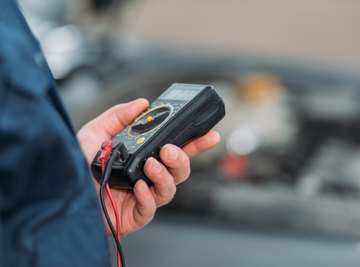

Magnetometers(sometimes written as "magneto meter") measure strength and direction of magnetic field, usually given in units of teslas. As metallic objects come into contact with or come close to the Earth's magnetic field, they exhibit magnetic properties.
For materials with such composition of metals and metallic alloys that let electrons and charge flow freely, magnetic fields are given off. A compass is a good example of a metallic object coming into interactions with the Earth's magnetic field such that the needle points to the magnetic north.
Magnetometers also measure the magnetic flux density, the quantity of magnetic flux over a certain area. You can think of flux as a net that lets water flow through it if you angle in the direction of a river's current. The flux measures how much of the electric field flows through it in this way.
You can determine the magnetic field form this value if you measure it over a specific planar surface such as a rectangular sheet or a cylindrical case. This lets you figure out how magnetic field that exerts a force on an object or a moving charged particle depends on the angle between the area and the field.
The Sensor of the Magnetometer
The sensor of a magneto meter detects the magnetic flux density which can be converted to magnetic field. Researchers use magnetometers to detect iron deposits in the Earth by measuring the magnetic field given off by various structures of rock. Scientists can also use magnetometers to determine the locations of shipwrecks and other objects under the sea or under the earth.
A magnetometer can either be vector or scalar. Vector magnetometers detect flux density in a specific direction in space depending on how you orient it. Scalar magnetometers, on the other hand, detect only the magnitude or strength of the flux vector, not the position of angle at which it's measured.
Uses of the Magnetometer
Smartphones and other cell phones use built-in magnetometers to measure magnetic fields and determine which way is north through the current from the phone itself. Usually smartphones are designed with the purpose of being multidimensional for the applications and features they can support. Smartphones also use the output from a phone's accelerometer and GPS unit to determine location and compass directions.
These accelerometers are built-in devices that can determine the position and orientation of smart phones such as the direction which you're pointing it. These are used in fitness-based apps and GPS services by measuring how quickly your phone accelerates. They work by using sensors of microscopic crystal structures that can detect precise, minute changes in acceleration by calculating the force exerted upon them.
Chemical engineer Bill Hammack said engineers create these accelerometers out of silicon such that they remain secure and stable in smartphones while they move. These chips have a part that oscillates, or moves back and forth, that detect seismic movements. The cell phone can detect the precise movement of a silicon sheet in this device to determine acceleration.
Magnetometers in Materials
A magnetometer can vary greatly on how it works. For the simple example of a compass, the needle of a compass aligns itself with the north of the Earth's magnetic field such that, when it's at rest, it's at equilibrium. This means the sum of the forces acting upon it is zero and the weight of the compass's own gravity cancels out with the magnetic force from the Earth that acts upon it. Though the example is simple, it illustrates the property of magnetism that lets other magnetometers work.
Electronic compasses can determine which direction is the magnetic north using phenomena such as the Hall effect, magnetoinduction, or mangetoresistance.
Physics Behind the Magnetometer
The Hall effect means conductors that have electrical currents flowing through them create a voltage perpendicular to the field and direction of the current. That means magnetometers can use semiconducting material to pass current through and determine whether a magnetic field is nearby. It measures the way current is distorted or angled due to the magnetic field, and the voltage at which this occurs is the Hall voltage, which should be proportional to the magnetic field.
Magnetoinduction methods, by contrast, measure how magnetized a material is or becomes when exposed to an external magnetic field. This involves creating demagnetization curves, also known as B-H curves or hysteresis curves, that measure the magnetic flux and magnetic force strength through a material when exposed to a magnetic field.
These curves let scientists and engineers classify material that makes up devices like batteries and electromagnets according to how those materials respond to external magnetic field. They can determine what magnetic flux and force these materials experience when exposed to the external fields and classify them by magnetic strength.
Finally, magnetoresistance methods in magnetometers rely on detecting an object's capacity to change electrical resistance when exposed to an external magnetic field. Similarly to magnetoinduction techniques, magnetometers exploit the anisotropic magnetoresistance (AMR) of ferromagnets, materials that, after being subject to magnetization, show magnetic properties even after the magnetization has been removed.
AMR involves detecting between the direction of electric current and magnetization in the presence of magnetization. This happens as the spins of the electron orbitals that make up the material redistribute themselves in the presence of an external field.
The electron spin is not how an electron actually spins as though it were a spinning top or ball, but is, rather, an intrinsic quantum property and a form of angular momentum. The electrical resistance has a maximum value when the current is parallel to an external magnetic field so that the field can be calculated appropriately.
Magnetometer Phenomena
The mangetoresistive sensors in magnetometers rely on fundamental laws of physics in determining magnetic field. These sensors exhibit the Hall effect in the presence of magnetic fields such that the electrons within them flow in an arc shape. The greater the radius of this circular, rotating motion, the larger the path the charged particles take and the stronger the magnetic field.
With increasing arc motions, the path has a greater resistance as well so the device can calculate what sort of magnetic field would exert this force on the charged particle.
These calculations involve the carrier or electron mobility, how quickly an electron can move through a metal or semiconductor in the presence of an external magnetic field. In the presence of the Hall effect, it's sometimes called the Hall mobility.
Mathematically, the magnetic force F is equal to the charge of the particle q time the cross product of the particle's velocity v and magnetic field B. It takes the form of the Lorentz equation for magnetism F = q(v x B) in which x is the cross product.
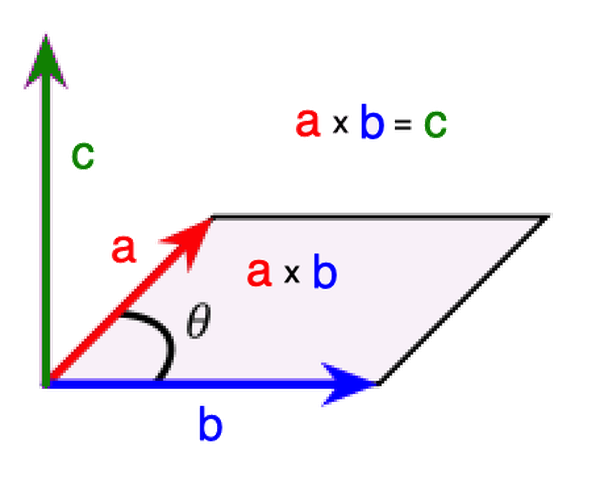
If you want to determine the cross product between two vectors a and b, you can figure out that the resulting vector c has the magnitude of the parallelogram that the two vectors span. The resulting cross product vector is in the direction perpendicular to a and b given by the right-hand rule.
The right-hand rule tells you that, if you place your right index finger in the direction of vector b and your right middle finger in the direction of vector a, the resulting vector c goes in the direction of your right thumb. In the diagram above, the relationship between these three vector's directions is shown.

The Lorentz equation tells you that with greater electric field, there is more electric force exerted on a moving charged particle in the field. You can also relate three vectors magnetic force, magnetic field and velocity of the charged particle through a right-hand rule specifically for these vectors.
In the above diagram, these three quantities correspond to the natural way that your right hand points in these directions. Each index and middle finger and thumb corresponds to one of the relationship.
Other Magnetometer Phenomena
Magnetometers can also detect magnetostriction, a combination of two effects. The first is the Joule effect, the way a magnetic field causes the contraction or expansion of a physical material. The second is the Villari effect, how the material subjected to external stress changes in how it responds to magnetic fields.
Using a magnetostrictive material that exhibits these phenomena in ways that are easy to measure and depend upon one another, magnetometers can make even more precise and accurate measurements of magnetic field. Because the magnetostrictive effect is very small, devices need to measure it indirectly.
Precise Magnetometer Measurements
Fluxgate sensors give a magnetometer even more precision in detecting magnetic fields. These devices consist of two metal coils with ferromagnetic cores, materials that, after being subject to magnetization, show magnetic properties even after the magnetization has been removed.
When you determine the magnetic flux or magnetic field that result from the core, you can figure out what current or changed in current might have caused it. The two cores are placed next to each other such that the way the wires are wound around one core mirror the other one.
When you send an alternating current, one that reverses its direction at regular intervals, you produce a magnetic field in both cores. The induced magnetic fields should oppose one another and cancel each other out if there is no external magnetic field. If there is an external one, the magnetic core will saturate itself in response to this external field. By determining the change in magnetic field or flux, you can determine the presence of these external magnetic fields.
The Magnetometer in Practice
The applications of any magnetometer range across disciplines in which magnetic field is relevant. In manufacturing plants and automated devices that create and work on metallic equipment, a magnetometer can ensure that machines maintain appropriate direction when they perform actions such as drilling through metals or cutting materials into shape.
Laboratories that create and perform research on sample materials need to understand how various physical forces such as the Hall effect come into play when exposed to magnetic fields. They can classify magnetic moments as diamagnetic, paramagnetic, ferromagnetic or antiferromagnetic.
Diamagnetic materials have no or few unpaired electrons so don't exhibit much magnetic behavior, paramagnetic ones do have unpaired electrons to let fields flow freely, ferromagnetic material show magnetic properties in the presence of an external field with the electron spins parallel to the magnetic domains, and antiferromagnetic materials have the electron spins antiparallel to them.
Archaeologists, geologists and researchers in similar areas can detect properties of materials in physics and chemistry by figuring out how the magnetic field can be used to determine other magnetic properties or how to locate objects deep underneath the Earth's surface. They can let researchers determine the location of coal deposits and map the Earth's interior. Military professionals find these devices useful for locating submarines, and astronomers find them beneficial for exploring how objects in space are affected by the Earth's magnetic field.
References
Resources
About the Author
S. Hussain Ather is a Master's student in Science Communications the University of California, Santa Cruz. After studying physics and philosophy as an undergraduate at Indiana University-Bloomington, he worked as a scientist at the National Institutes of Health for two years. He primarily performs research in and write about neuroscience and philosophy, however, his interests span ethics, policy, and other areas relevant to science.