
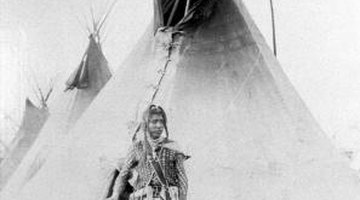


Tepees or tipis are the name of dwellings used by American Indians. Typically, they were constructed of poles arranged and fastened into a conical frame covered by animal skins. A hole was left in the top for smoke to escape and a flap was created to allow movement in and out of the teepee. Although these structures were highly mobile, the design still provided a solid shelter for the American Indians. Tepees often were decorated elaborately with symbols that had strong meaning for the owner.
Supporting Poles

Tepee poles were peeled wooden limbs, usually made from lodge pole pine. Any long, thin tree limb could be used and often are found where trees grow in crowded conditions discouraging branching. The harvested poles were thin, smoothed down by hatchets and knives. A teepee’s strength relied on its three strongest foundational poles. Once the first three poles were tied together and positioned, the rest of the poles filled in the spaces in between to complete the structure.
Hide Covering

Most often, American Indians used buffalo hides for their teepee covers. A dozen or more buffalo hides had to be scraped, tanned, sewn and then braided together to create a half circle to cover the teepee. The outside of the teepee was painted, often depicting the achievements of the family that lived in the teepee. When it rained or snowed, the men of the family added an extra layer of hide around the teepee.
Life Inside

A teepee’s occupants only needed a small fire to keep warm in cold weather and to cook. Two flaps were cut into the top section of the teepee to open when smoke needed to escape. The family slept on buffalo skins on the ground. The head of the family situated himself at the farthest point from the teepee opening flap or doorway. Some teepees had pockets sewn on the inside of the structure to store clothing and other family possessions. A teepee’s flap was left open when visitors were welcome. When it was closed, a visitor was expected to ask permission to enter.
Positioning

A teepee’s doorway flap was always positioned toward the East, weather permitting. This allowed the structure’s door to face the rising sun. If the weather was severe, the flap was situated in the best position to protect its occupants. A circular teepee arrangement was used in many tribal units. In this way, the smaller children could play in a protected space, watched over by their mothers.
Related Articles







Resources
- "Tipis, Tepees, Teepees : History and Design of the Cloth Tipi"; Linda Holley; 2007
Writer Bio
Based in eastern Virginia, Cathy Welch began writing nonfiction articles and novels in 1996. She wrote a short story that appears in John Maxwell’s “Everyone Communicates, Few Connect.” She writes reviews and nonfiction for Longridge Writer’s Group. Welch holds a Bachelor of Science in business administration from Christopher Newport University with a concentration in management.