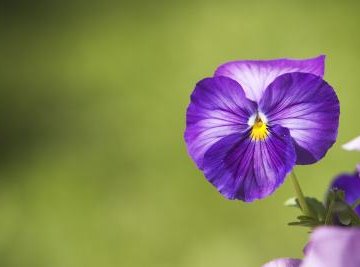

Imagine a rosebush. You are probably picturing it as a leafy, thorny shrub with tons of bright flowers. Now imagine a pine tree. Needles, cones and a long trunk come to mind, but what about the flowers? Flowers are reproductive structures, so the must be important. But guess what? Many plants get along just fine without flowers. Generally, plant life can be broken up into two groups: flowering plants and nonflowering plants. While flowers are a dividing line, they are not the only big difference between the two groups.
What Are Flowering Plants?
Flowering plants are all related to each other on the tree of life. That is to say, they all descend from an ancestor that produced flowers. All of the members of this group are called angiosperms. This group contains plants like the flowering dogwood (Cornus florida) and rose bushes (Rosa spp.).
There are roughly 300,000 known species of angiosperms, making this the largest plant group on the planet. It contains more species that all of the groups of nonflowering pants put together. Despite being incredibly diverse, all angiosperms have a few traits in common that unite them as a family.
First, they all produce flowers of some kind. They are not all big and showy, either. All flowers, showy and dull, have the same purpose. Flowers produce seeds. Specifically, they produce fruits that contain hardy seeds surrounded by a seed coat. This coat is able to protect the embryo within until conditions are favorable for germination. These plants also have vascular tissue, which allows water and nutrients to be transported throughout the plant.
Examples of Flowering Plants
Flowering plants make up 80 percent of plant diversity on the planet, so there are many examples of flowering plants. In fact, most of the plants you are familiar with produce flowers. Many trees are flowering plants, like the red maple tree (Acer rubrum) and the Japanese cherry blossom (Prunus serrulata). Common houseplants like orchids (Orchidaceae) and lilies (Lilium spp.) are also great examples of flowering plants.
What Are Nonflowering Plants?
While most green plant life is composed of a large number of rather closely-related angiosperms, nonflowering plants are spread across several botanical categories. You're likely to be the most familiar with gymnosperms. Gymnosperms are a more primitive lineage than angiosperms, and evidence suggests angiosperms actually evolved from gymnosperms. The rest of the nonflowering plants are more primitive than gymnosperms, and they do not produce seeds. These are known as seedless vascular plants and seedless nonvascular plants.
What Are Gymnosperms?
Of the nonflowering plants, gymnosperms are the most closely related to flowering plants, and because of that, they are the most similar to them. Gymnosperms, much like angiosperms, are complex plants with vascular tissue that produce seeds. Where they are different is that they do not produce flowers.
Instead, gymnosperm seeds originate inside of reproductive structures called cones. Where flowers often rely on insect pollination, and thus attract those insects with bright flowers, gymnosperms rely on other methods, such as wind pollination. Their seeds develop within the cone, as opposed to developing within fruit as is the case with flowering plants.
Finally, the seeds that come from cones are different from the seeds that originate in flowers. The word gymnosperm literally means 'naked seed,' and this refers to the fact that the seeds lack a protective coating. Instead, the cone can act as a protective structure for the seeds, sometimes preserving them for many years before releasing them.
While gymnosperms are rarer than flowering plants, there are a handful of examples you are likely familiar with. Conifer trees, like the Fraser fir (Abies fraseri), the red spruce (Picea rubens) and the white pine (Pinus strobus), are all gymnosperms.
Seedless Vascular Plants and Seedless Nonvascular Plants
Gymnosperms are not the only nonflowering plants to talk about. There are two other groups that deserve a mention: seedless vascular plants and seedless nonvascular plants.
These groups are much more primitive than angiosperms and gymnosperms. As you can tell by the name, neither group produces seeds. Instead, they reproduce by releasing sperm into water. This fertilizes egg cells to produce embryos that develop into new plants directly.
Seedless vascular plants are often big and leafy. They are able to reach large sizes because they have vascular pipelines that allow them to pull water from soil. The big, leafy plant will produce spores on the underside of its leaves. These spores will fall off and grow into a tiny version of the plant called a gametophyte, which reproduces sexually.
As far as seedless vascular plants go, the kinds you are probably most familiar with are ferns. There are lots of types of ferns, and you often see them as house plants.
Seedless nonvascular plants are even more primitive, as they lack seeds and vascular tissues. Because of this, they are often small, and confined to damp locations where they can absorb water without the aid of roots. The most common example of seedless nonvascular plants are mosses. This group also contains liverworts and hornworts, but those are much less common.
References
About the Author
Cameron is a writer and educator based out of Fort Collins, Colorado. His work has appeared in New Scientist, LiveScience, Discovery's Curiosity Daily podcast, and MinuteEarth. He teaches Ecology and Evolution at the University of Northern Colorado.
Photo Credits
Ingram Publishing/Ingram Publishing/Getty Images