
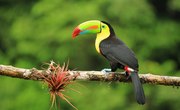
A rainforest is a magical place thriving with all manner of plants and animals. Many times we only see the ones flying through the air or that are big enough to catch our attention, but there is a whole group of animals that live in the rainforest floor.
Carnivores, omnivores, and herbivores in the rainforest call the forest floor home.
The Rainforest
Rainforestanimals.net defines a rainforest as an dense forests that receives large amounts of regular rainfall. They are most often in tropical regions, although some exist in temperate regions (usually near oceans, as with the temperate rainforests of the Pacific Northwest).
Large tropical rainforests abound in parts of South America, Africa and Asia.
Layers of the Rainforest
There are four layers found in a rainforest. The emergent layer has trees that reach above-average heights compared to other trees in the rainforest; some trees can grow to 200 feet or more. Insects, bats and birds are found living in the emergent layer.
The canopy is the next layer, which is made up of trees between 100-150 feet. The canopy is home to lots of tree-dwelling plants and animals. In the canopy you will find spider monkeys, lemurs, sloths, parrots and toucans. Those animals get most of their food in the canopy and rarely leave that layer.
Under the canopy is the understory. That is where leaves of trees are large (due to the diminished amount of sunlight filtering through the upper layers) and is where many insects live.
The last layer of the rainforest is the floor. That area only gets a very small percentage of the sunlight filtering through the upper layers. It is mostly covered with small plants and decomposing vegetation and is the domain of land-dwelling forest floor animals.
Cats Are Forest Floor Animals
Rainforests.mongabay.com states that the largest group of forest floor animals consists of the jungle cats. Each rainforest, except for Australia, has its own cat species. The largest is the tiger, but it is threatened by extinction due to loss of habitat.
There are five species of tiger left living in rainforests. The Bengal or Indian tiger is the most common.
Jaguars also live on the rainforest floor and can be found in Amazon rainforests. The jaguar is endangered due to over hunting for its fur. Jaguars eat frogs, fish, turtles, deer and caiman. Jaguars are great swimmers and like to fish and hunt at night.
Leopards also live in rainforests from Asia to Africa and are smaller cats. Pumas are an even smaller species. The ocelot can sometimes be found in the rainforests of South and Central America, and is about the size of a typical housecat.
Other Carnivores
The most known rainforest animal from the civet family is the mongoose. It is able to open eggs and feed on them. They also feed on insects, small mammals, snakes and birds.
Armadillos can also found on the forest floor from the southern United States to the southern tips of South America. Because of their exterior, they are almost inedible to other carnivores. Armadillos are great diggers and eat snakes, mice, lizards and insects.
They can get as big as 120 pounds. Rainforests also are host to a large number of carnivorous reptiles (snakes and crocodiles, for example).
Omnivores and Herbivores in the Rainforest
Rainforest pigs are commonly found in all types of rainforests. They dig in the ground searching for food and create holes in the ground that fill with water when it rains. Those holes collect water and are then home to many types of insects and even fish.
Rainforest pigs are often found in large groups and herd together to help protect themselves from predators. Rainforest pigs include wild boars, warthogs and babirusa.
There are also birds that live on the rainforest floor like the southern cassowary, which is the second heaviest bird on earth after the ostrich. Cassowary's live in the dense foliage of rainforests in New Zealand and Australia, eating fruits, leaves and insects. They redistribute seeds in their feces.
There also are mammalian herbivores in the rainforest that inhabit the rainforest floors. For example, the okapi in Africa resembles a striped deer. It eats grass, fruit and leaves on the rainforest floor and likes to live in clearings found on the rainforest floor. They can weigh up to 600 pounds and are 5 to 6 feet in height.
Considerations
Rainforestanimals.com states that 50 percent of the world’s species of plants and animals are plants and animals that live in the rainforest floor and other layers.
Rainforests only account for 6-7 percent of the surface area on Earth. Most animals have adapted to live in the thick rainforest floor and in tropical conditions. We can’t forget that there are also indigenous people who live on the rainforest floor, such as the Kayapo, Pygmies and Huli.
Many of the rainforests have been affected by human development and activities such as deforestation and logging, and settlements and farming. The Rainforest Alliance, The Nature Conservatory, and the Rainforest Action Network are all groups helping to conserve the rainforests and the animals that live in the rainforest floor.
References
Resources
About the Author
Sarah Lipoff has been writing since 2008. She has been published through BabyZone, Parents, Funderstanding and Education.com. Lipoff has worked as a K-12 art teacher, museum educator and preschool teacher. She holds a Bachelor of Science in K-12 art education from St. Cloud State University.