
Roman Domes & Arches

Roman Domes & Arches thumbnail
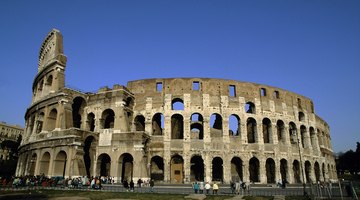
The arches of the Colosseum are able to support its massive weight.

The Roman use of domes and arches made it possible for them to build massive structures that are wonders of beauty and strength. Roman domes and arches later led to the vaulted ceilings of the Middle Ages’ Gothic cathedrals, and have continued to influence architecture today. In their own time, the Roman’s innovations were advancements vital to their empire’s continuing expansion, and many Roman domes and arches are still standing to attest to their skill and vision.

  1. Invention

    • Before the Romans began to master architecture using arches, domes and columns in the 1st century B.C., the primary architectural support system was the post and lintel, where two posts support a beam laid flat above them. Though the Romans did not invent domes and arches, they improved their designs and utilized them so well that they are often credited as their inventors. It was the Roman mastery of the arch that led to the creation of the dome: a collection of arches that meet in the middle.

    Support

    • The post and lintel building technique used by previous civilizations was limited because posts had to be spaced close together to provide the support needed. For example, in Greek structures built with stone lintels, one lintel can support two posts up to 7 yards apart. A Roman arch can span and support 50 yards, thus enabling the Romans to build massive structures.

    Composition

    • Greek post and lintel architecture was also limiting because a single large stone was required to provide the lintel. A benefit of the Roman arch was that it could be made up of smaller pieces of stone or brick, rather than one single piece. Both domes and arches are held together by pressure exerted on the bricks or stones from the outside that pushes them tightly against each other.

    Concrete

    • One key to the strength of Roman domes and arches was the concrete used in their construction. The Greeks invented cement around 200 B.C., and the Romans adapted and improved it when they began adding ground volcanic lava in place of clay. When they included volcanic rubble into the mix as well, they made a strong concrete. An inner layer of concrete under domes or arches bonded the pieces together and added a layer of support.

    Famous Examples

    • The Pantheon, built in 120 A.D., is one famous example of the Roman dome that is still standing. Built by Emperor Hadrian as a temple to the gods, the Pantheon is a massive dome with a relatively small circle in the middle of the roof open to the sky. The Colosseum is an impressive example of the use of Roman arches. Once able to house an audience of 55,000, it has sadly fallen into disarray since its completion in 80 A.D. The remaining structure, however, still attests to the Roman mastery of the arch.

Related Searches:

References

  • Photo Credit the famous roman landmark image by Piter Pkruger from Fotolia.com

Comments

You May Also Like

  • What Are Roman Domes?

    Roman domes were an architectural design created by the Roman empire for structural and decorative use. The influence of this design can...

  • Roman Arch Definition

    People often refer to the arch, in architecture, as the Roman arch because the ancient Romans used it widely in their building...

  • How to Build Large Clear Plastic Domes

    You can make large plastic domes outside to cover your plants in the wintertime, protect ponds from freezing or to create a...

  • Types of Domes

    Domes are a recognizable staple of architecture going back thousands of years. They have been used on many memorable buildings and sites,...

  • How to Convert the Greek Numerical Alphabet

    The ancient Greek civilization made advancements in many areas, including several in mathematics. In their calculations they used a number system based...

  • Benefits of a Roman Arch

    Benefits of a Roman Arch. Although the Romans did not invent the arch, they did perfect and popularize it. One reason they...

  • Uses of the Roman Arch

    Aqueducts are systems used to carry water to cities. One of the most critical factors in creating a viable city within the...

  • Famous Roman Aqueducts

    Famous Roman Aqueducts. An aqueduct is an ancient system designed to move fresh water from a source to a town. During the...

  • Influences of the Greek & Etruscan Civilizations on Roman Art

    Ancient Rome is traditionally regarded as the birthplace of modern Western art and culture. Characterized by grandiose architecture and monumental sculptures, Rome...

  • Parts of an Arch in Roman Architecture

    Parts of an Arch in Roman Architecture. Ancient Rome greatly influenced architecture, and continues as a major influence even today. One architectural...

Related Ads

Featured