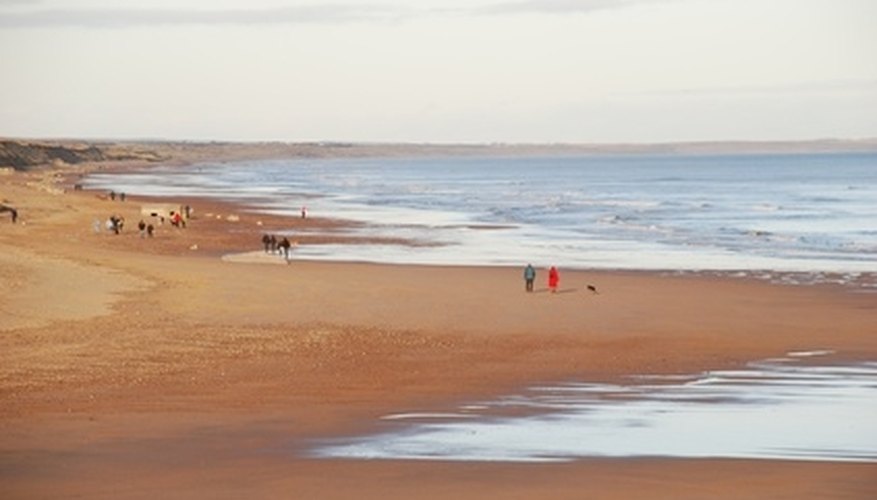


Beach paddleball is a game with a number of variations. Those who hit the ball back and forth can play competitively or together as a team, trying to keep the ball alive for as long as possible. The game has become a sort of sport in Israel, with literally hundreds of people playing together on the country's beaches. Israel has even asked the Olympic Committee if it can be considered a sport at the 2012 Olympic Games in London.
Equipment and Players
Beach paddleball requires at least two players but can also have as many as three or four. It also requires an expanse of beach and is usually played close to the waterline. There are certain types of equipment that are also standard to playing paddleball. The paddles are large flat pieces of wood 16 inches in length and flat pieces of light wood with handles that are either made out of plastic or have plastic grips. The ball is a hollow rubber ball, an inch in diameter.
Competitive Play Rules
Rules for the game when players are playing against each other competitively are relatively simple. Equal boundaries are determined for each player's side, with a line in the middle that a player must hit the ball over to get to the other person's side. There are boundaries in the back and along the edges of the sandy court and these boundaries can be any size a player chooses. The object is to not let the paddleball touch the ground. One player serves the ball to another player in the air and they must hit it back to their opponent's side before it bounces on the ground, trying to hit in bounds without the other player hitting it back. Players hit the ball back and forth until it lands in bounds or the ball goes out. Players play to a certain number they decide and can win by two. Some people play by rules that are similar to tennis, with one side serving and then another side serving.
Group Play
Another way to play beach paddleball is to play as a group. With two to four people, players try to keep the ball airborne for as long as possible, hitting between each person in a set area. The ball cannot touch the ground or else the groups will have to start over counting from the beginning. Groups can compete against each other with each one seeing who can keep the ball in the air the longest or exchange the most hits. This creates an exciting game to play on a team and also one to watch as an observer, as it will be numerous people swinging and diving for small rubber balls in the sand and surf.
References
Writer Bio
Hailing from Austin, Texas, Daniel Westlake has written under pen names for a myriad of publications all over the nation, ranging from national magazines to local papers. He now lives in Los Angeles, Calif. but regularly travels around the country and abroad, exploring and experiencing everything he can.