How is Opal Made?

How is Opal Made? thumbnail
Opals are known for their rainbow ripples of color and light.

While the largest reserve of opals are in Australia, the stones have been unearthed worldwide. The vibrant, firecracker of colors inherent in the gems have stirred imaginations in numerous cultures. From a scientific point of view, the opal fascinates as it is an example of how the friction between water and light can create luminous stones. Does this Spark an idea?

  1. Identification

    • Unlike minerals, mineraloids do not have a crystal structure.
      Unlike minerals, mineraloids do not have a crystal structure.

      Opals are distinguished by their iridescent, rainbow-like fluttering of colors. Technically, opals are mineraloids, which are similar to minerals. Minerals are solids that form naturally in the earth and have a crystalline composition, otherwise known as a specific arrangement of particles. Mineraloids, such as opals, amber and obsidian, lack crystallinity but are still contain chemical compositions. Specifically, opals are a mix of hydrous silicon dioxide and between three and 21 percent water. Silica is a transparent, colorless crystal found in glass and ceramic. Opals are formed when water sluices downward through the earth, absorbing sandstone along the way. The sandstone in turn saturates the water with silica, which then settles between breaks in the earth. Water evaporates, leaving a silica residue behind. As the process repeats itself, opal is slowly formed.

    Effects

    • The way light moves through opal's chemical composition is what makes the colors so intense.
      The way light moves through opal's chemical composition is what makes the colors so intense.

      The hydrated chains of silica and oxygen create microscopic spheres. According to the U.S. Geological Survey, when light cuts through the spheres, it causes the variegated prisms of color. This disproves the assumption that the water alone stimulates the coloration, a fact that wasn't discovered until Australian scientists unlocked the secret in the 1960s.

    Geography

    • The Great Artesian Basin is a huge source of opals.
      The Great Artesian Basin is a huge source of opals.

      While roughly 5 percent of opal fields exist in Mexico, Brazil, Ethiopia, Mali and even America in the states of Idaho and Nevada, 95 percent of the stones are located in and around the Great Artesian Basin, an area that stretches from Queensland to the northeastern portion of South Australia and the northwestern region of New South Wales; roughly a fifth of the country of Australia. The area is opal-rich because it was submerged in water during the age of the dinosaurs.

    Processing

    • Opal cutters use sandpaper and wet leather wheels to refine the opals shape.
      Opal cutters use sandpaper and wet leather wheels to refine the opals shape.

      Once opals are unearthed, they are polished and cut into oval or round cabochons, a French word that defines gems cut in convex shape, (a shape that curves outward like a circle's circumference). The opal cutter then uses a diamond cutting wheel to shave off impurities and to roughly shape the stone. Sandpaper is used to finalize the shape before the opal is perfected with a wet leather wheel.

    HIstory/Legend

    • Aborigines believed that rainbows were the source of the opal's color.
      Aborigines believed that rainbows were the source of the opal's color.

      Gemselect.com quotes the words of the famous Roman author, Pliny, who praised the opal as being a stone that "combines the fine sparkle of almandine, the shining purple of amethyst, the golden yellow of topaz and the deep blue of sapphire." The Greeks cherished opals for it was said that they were the elated tears that Zeus wept after he bested the Titans. In Arabic culture, opals were supposedly born from lightning. Aborigines, meanwhile, worshiped the stone because they believed that the creator descended from the heavens on a rainbow and left rainbow-colored stones with every earthbound step he took.

    Theories/Speculation

    • According to gemstone.org, one speculation is that the opal got its name from the Sanskrit word "upola," which means "valuable stone." Another hypothesis is that it stems from the Greek word for "color change," "opallios," or from the Roman word "opalus" which translates to "stone from several elements."

    Types

    • Aztecs and Mayans used the fire opal in many rituals.
      Aztecs and Mayans used the fire opal in many rituals.

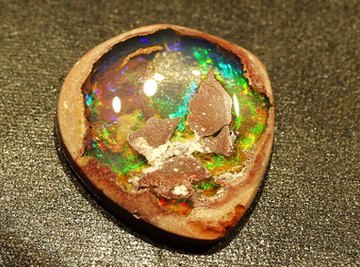
      Opals come in many different types, the rarest and most costly being the black opal. Its opaque body is solid and sometimes has slivers of peacock-blue color. Roughly 99.9 percent of black opals are mined in Mintabie and Andamooka, Australia. Light opal deposits are centered in South Australia and are identified by the shades of bright blue scintillating across the moonstone-white surface. Fire opals are commonly found in Mexico's highlands, along the edge of dormant volcanoes. Mayans and Aztecs referred to the fiery-red stone as the "stone of the bird of paradise" and used it in many rituals. With a respectable hardness that averages between 6 and 6.5 out of 10 on the Mohs scale of mineral hardness, it is considered the official stone of Mexico.

Related Searches:

References

  • Photo Credit Mexican Cantera Opal image by Mexgems from Fotolia.com mineral image by Marek Kosmal from Fotolia.com Precious Mexican Supreme Opal image by Mexgems from Fotolia.com australia image by Orlando Florin Rosu from Fotolia.com opal image by Stephanie Bandmann from Fotolia.com rainbow image by João Freitas from Fotolia.com mexican art moon image by Jim Mills from Fotolia.com

Comments

You May Also Like

  • How Are Opals Made?

    Opals are considered semi-precious gemstones. Opals are naturally forming with over 95 percent of natural opals originating in Australia, which are harvested...

  • How to Care for a Man-made Opal Ring

    Man-made opal rings are quite beautiful, bearing a close resemblance to natural opal with iridescent rainbow markings. Synthetic opal rings are sometimes...

  • What is Mineral Oil Made of?

    Mineral oil, also called liquid petroleum, paraffin oil or white mineral oil is an inexpensive byproduct produced in the purification of petroleum...

  • How to Repair an Opal Ring

    The stunning iridescence of opals is best highlighted in a ring setting. However, these fragile gemstones are in jeopardy of crazing and...

  • Mythology of Opals

    Opals, Australia's national gemstone, have been known and admired since the beginning of written history. Considered a semiprecious stone, opals come in...

  • How to Tell a Genuine Opal From a Synthetic

    Telling the difference between a real opal and a synthetic stone can be tricky because opals come in a rainbow of hues...

  • How to Clean Opal Rings

    Cleaning an opal ring is a two-step process, since the stone may be porous but the ring itself is likely made of...

  • How to Care for Opal Rings

    When the shimmery opal adorns jewelry pieces, the effect is startlingly beautiful. People born in the month of October are fortunate to...

  • The Difference Between Fire Opal & Fiery Opal

    The opal gemstones found throughout the world are known for their beautiful hues and glints of color. There is an important distinction...

  • Methods to Create Opals in a Lab

    Methods to Create Opals in a Lab. Opal is made of hydrated silica, or silicon dioxide. Its water content varies. Natural opals...

  • History of Opal Rings

    According to Opals Down Under--Australian experts in mining, cutting and selling opals--the gemstone was precious to early cultures because it brought forth...

  • What Is an Opal?

    The opal: a delightful quirk of nature, a wonder to behold. Mystery and myth surround this rich and lustrous stone. There is...

  • Australian Opal Information

    Opal is a precious gemstone, which is mainly found in Australia. Opal is one of six precious gemstones found on earth, the...

  • How to Identify a Fake Opal

    Fake opals can be fairly difficult to identify because the varieties and types of real opals are so diverse. However, there are...

  • How to Add Music to the RCA Opal

    The RCA Opal is an excellent portable device which you can use to listen to your favorite music, watch videos and even...

  • How to Clean Opal Jewelry

    Opal jewelry is made of silica spheres. That makes it beautiful but also delicate. Because opal is not a stone but rather...

  • How to Clean Fire Opal

    There are many kinds of opals, including the noble or precious opal, the common or potch opal and the fire opal. These...

  • What Is the Earth Made Of?

    Earth whirls its way through space almost 93 million miles away from the sun. As far as we know, it is the...

  • How to Care for Opals

    Comments. You May Also Like. How to Care for Opal Stones. Perhaps the most flirtatious and capricious member of the gemstone world...

  • What Is a Fire Opal?

    Found in large deposits in Mexico, fire opals date back to the Aztec and Mayan periods, according to the International Colored Gemstone...

Related Ads

Featured