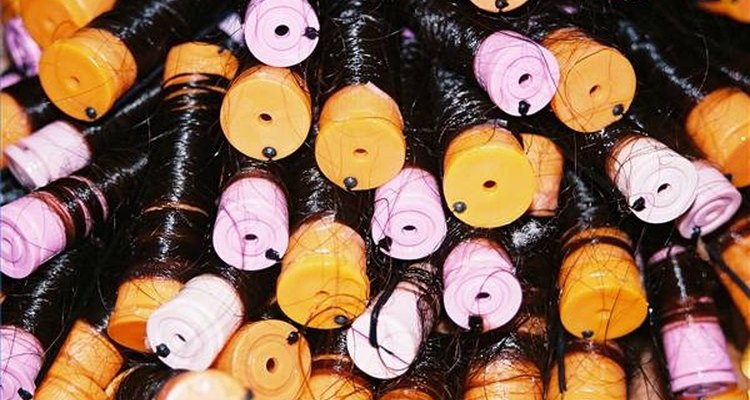
The active ingredient in perming lotion, whether for curling or straightening hair, is a chemical called ammonium thioglycolate. Ammonium thioglycolate is an ammonia salt of mercaptoacetic acid. Boxes of perm solution also list the ingredient as ammonium thyioglycolic acid. This article discusses the chemistry, characteristics, and hazards of the active ingredient of perming lotions and hair straighteners with tips for safe application.
Features
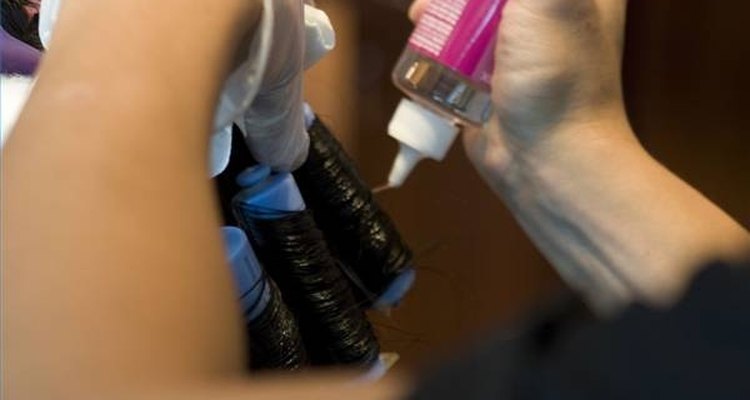
Ammonium thioglycolate is a colorless, clear liquid with a strong ammonia odor. Depending on the other ingredients in the perming lotion, the solution may not appear clear.
Function

Ammonium thioglycolate permanently changes the structure of hair. Treated hair remains either curly or straight, depending on application technique, until new hair growth requires an additional perm or straightening service.
A post on the MadSci Network from Dan Berger, a faculty member of Bluffton College's Chemistry Department, discusses the chemistry of perms. Hair primarily consists of a protein called keratin. Keratin contains a large proportion of the amino acid cysteine. Hair gets its shape from disulfide bonding between protein chains. These disulfide bonds form between atoms of sulfur found in the cysteine molecules.
Perming lotions containing thioglycolate break the disulfide bonds of hair proteins. Stylists shape hair with curlers or straighten using ceramic irons. Perm neutralizers containing hydrogen peroxide form new disulfide bonds, making hair either permanently curly or straight, depending on the application technique.
Warning
The material safety data sheet (MSDS) for ammonium thioglycolic acid lists potential hazards from inhalation, ingestion, and skin contact. Thioglycolate is "toxic if swallowed," irritates eyes, and causes an allergic reaction in some users. Prolonged or repeated use may lead to skin sensitization and sores. The MSDS states that three agencies (NTP, IARC, and OSHA) do not list thioglycolate as a cancer-causing agent known as a carcinogen.
The active ingredient in perming lotion, ammonium thioglycolate, is not biodegradable and harms water life. The perming lotion bottle should be completely empty before putting it in the trash. Avoid rinsing from hair in a way that contaminates surface water or soil.
Prevention/Solution

Wear gloves when working with thioglycolate, the active ingredient of perming lotion, helps prevent skin irritation and sensitization from repeated exposure. Do not use perming lotion on a person who shows signs of sensitivity, such as an irritated scalp. Never reuse towels to wipe away excess perm lotion; this may lead to inadvertently getting perming lotion in a person's eyes.
Minimize contact with the scalp when applying perm solution. Wash all the perming lotion from hair with warm water as soon as the perm is completely developed.
Wash skin immediately with soap and water if the perming solution gets on your skin during application. Wipe drips from the scalp as they occur.
Flush eyes for ten minutes with cool water if perm lotion gets in your eyes. Contact a doctor for further instructions.
Apply perming solution in an area with good air circulation. Open windows to get fresh air in small spaces like bathrooms. If you notice breathing irritation from the ammonium thioglycolate, go outside for fresh air.
Call Poison Control immediately at 1-800-222-1222 if someone digests perm solution. The ammonium thioglycolate is toxic. Do not induce vomiting. Rinse mouth with water and spit out. Then drink a few glasses of water and seek immediate medical attention.
Considerations
Perming lotion and straightening formulas containing ammonium thioglycolate are not compatible with previous lye-based hair relaxing treatments. Special perm lotion formulations exist for highly processed hair showing signs of chemical damage.
For optimal results, salon clients should not wash their hair for forty-eight hours after curling or straightening treatments with perming lotions containing ammonium thioglycolate.
Related Articles

Affirm Relaxer Ingredients
How Much Does Eyelash Perming Cost?
The Side Effects of Sodium Bisulfite
Dangers of Spray on Tan

Phisoderm Ingredients

How to Remove Hair Dye With a Developer

How to Make a Perm Curlier
The Effects of Perm Lotion on Hair ...

The Effects of Inhaling Air Dusters
Ingredients in Head & Shoulders ...
How to Get Rid of Calcium Buildup in ...
Ingredients in Maybelline Foundation

Can Hair Dye Cause Severe Itching of ...
How to Use Herbatint
What Are the Dangers of Getting a Perm?

How to Stop Hair Breaking From Roots
How to Disinfect Ear Plugs
Safety Concerns for Getting a Hair Perm

The Ingredients of Neutrogena Sensitive ...
How to Make a Weave Stop Itching
Writer Bio
Carla Boulianne is an evolutionary biologist by training and freelance writer by passion. In addition to writing for Demand Studios and eHow, she is feature writer for Parenting a Gifted Child at Suite101.com. She thrills in exploring new topics through extensive research.
Photo Credits
Mary Vogt@morgueFile, Caroline Tran@Flickr, Amy n Rob@Flickr, Anita Patterson@morgueFile, Kenny Corbin@Flickr