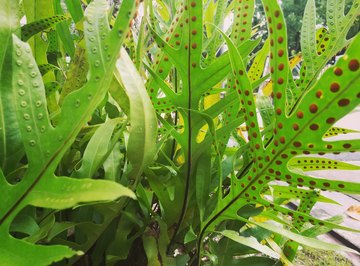

When weather conditions are ideal, some ferns, algae, moss and even fungi, release spores into the air, often carried by the wind, by insects or birds until they land. Spores contain both male and female reproductive organs, which allows these plants to replicate themselves in a form of cloning. Many scientists posit that -- at one time -- all plants reproduced using spores, but as life evolved, and began to adapt to the environment, plants started forming seeds.
TL;DR (Too Long; Didn't Read)
Asexual reproduction, such as with spore-producing plants, represents a form of cloning, as the new plant contains the exact same genetic material as the parent. All forms of asexual reproduction involve a separation of parts from the original plant. This form of reproduction allows asexual plants, when conditions are right, to reproduce rapidly and in large amounts. Asexual reproduction helps plants to survive in all types of environments.
Fertilization and Dispersal
For spore-producing plants, the fertilization process occurs after, rather than before, spore dispersal. When the air outside becomes dry, pressure builds up inside the plant. The pressure then forces the plant to eject thousands of small spore cells into the air. Spores can survive very harsh conditions and, since they contain no food matter in them, most predators will not eat them. Once the spore lands, if conditions are right, the gametophyte phase begins.
Warm, Moist and Shaded
To provoke the gametophyte phase, spores must land in warm, moist and shaded areas. Each spore has a small chance of landing in an ideal spot, which is why spore-bearing plants eject hundreds of spores in hopes that some will land in suitable environs, but only about 1 percent survive the process.
Gametophyte Phase
The gametophyte phase begins when the spore splits, forming two genetically identical cells that fuse together to grow into a small, heart-shaped structure called a prothallus. The prothallus germinates, or grows, several root-like hairs called rhizoids to secure itself to the ground. After several weeks of growth, but the male and female reproductive organs develop from the prothallus. The female organs produce small egg cells, ova, while the male organs produce sperm.
Fertilization Process
To begin the fertilization process requires rain. Once it begins to rain, the sperm swims down the long neck of the prothallus to its base, where it finds the ova. As in mammal reproduction, the sperm fuses with the egg to produce an embryo. The embryo grows into a new spore producing plant. Once fully developed, this new plant again ejects its spores and the entire cycle begins again.
References
About the Author
Jessica Saras is a professional editor and copywriter. After earning an English degree from Reinhardt College, Saras completed the summer writing program at Sarah Lawrence College. A natural-born writer, she has more than six years of experience in web content development. In addition to being a full-time copywriter, she writes articles for Demand Studios, wiseGEEK.com, Examiner.com, and Suite101.com.