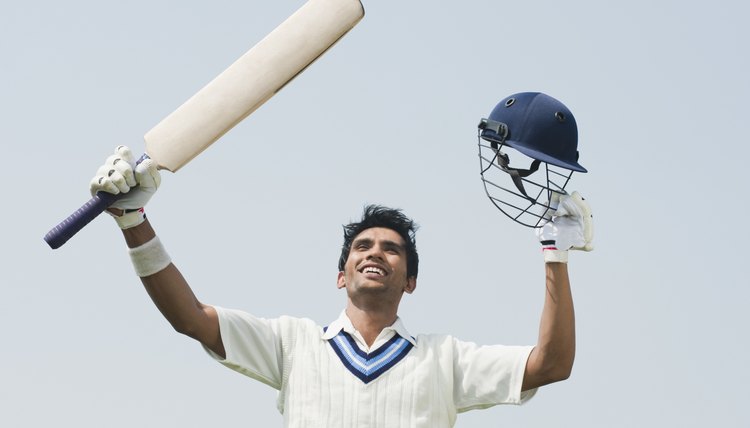
Cricket Description for Americans

Cricket Description for Americans thumbnail
Cricket is growing in popularity around the world.

The origins of cricket were first recorded in England in the 17th century. The sport has become popular all over the world but it can appear to be a confusing game when first watched. Cricket is the fastest growing sport in America, with the twenty over version of the game increasing in popularity. The object of the game is to score more than the opposition. It is contested by two teams consisting of 11 players each, taking turns to bat and bowl. A toss of a coin between the two captains denotes who will bat or bowl first.

  1. Aim

    • The batting team tries to score as many runs as possible by hitting the ball with the bat. The cricket field is oval-shaped with a 22-yard playing pitch, called a wicket, in the center. Two batsmen take to the field at one time. One batsman plays at each end of the wicket. The bowling team bowls overarm to the batsman but also try to hit the three stumps at the end of the wicket. The batsman attempts to stop the ball hitting the stumps, otherwise he is out and his inning has ended. He will be replaced by another batsman. When 10 batsmen are out, the teams swap and the bowling side bats. The eleventh batsman will remain not out but the inning is ended. A batsmen is required at each end of the pitch. The bowler is required to perform a legal bowling action, namely, he takes a run up and must keep his bowling arm straight as he brings the ball from behind his head, past his ear and releases when his hand is at eye level.

    Scoring Runs

    • The bowler releases the ball aiming for the stumps. The batsman scores a run when he hits the ball and runs between the two sets of stumps. The second batsman must also run to the opposite end of the pitch. Four runs will be scored if the ball is hit and touches or rolls over the edge of the cricket field, usually a roped boundary. Six runs are scored if the ball is hit over the roped boundary without hitting the ground.

    Bowling and Fielding

    • The object of the bowling team is to remove 10 batsmen by getting them out. The player must bowl overarm keeping his bowling arm straight. He will bowl six consecutive bowls that make up an over. The batsman can be out in a number of different ways. The batsman will be "clean bowled" if the bowler hits the stumps with a bowl. The bowler's team members are called fielders and they can remove the batsman if he hits the ball and is caught without hitting the ground. A batsman can be out if the ball hits his leg and the referee or umpire deems the ball would have traveled on to hit the stumps. This is called "leg before wicket" or L.B.W. A run-out will also remove the batsman. This is when a batsman attempts to score a run and the fielding team throw the ball and hit the stumps before he reaches the batting line, called a crease. A batsman will be given out in several other ways but they are less frequent, including handling the ball, timed out, double hit, hit wicket and obstructing the field.

    Umpires and Captains

    • The cricket umpire is the official who referees the game. He will make decisions such as whether the batsman is out L.B.W., if the bowler bowls a "no-ball," which is an illegal delivery, or if the pitch is playable. He will know the rules and he makes sure that the players are informed of his decisions. Each team will have one nominated player as captain, who will liaise between his team and the umpire.

    Terms Used

    • Understanding the terms used in cricket helps to follow the game. Some of the most common terms used are -
      Block - A defensive stroke played by a batsman
      Bouncer - A bowl that is pitched short and bounces high around the batsman's head
      Drive - An attacking shot that rolls past the fielders
      Duck - A score of zero by a batsman
      Full Toss - When a bowler bowls a ball that does not bounce before reaching the batsman
      Hook - A shot played by a batsman from a bouncer
      Over - Six consecutive bowls by a bowler
      Maiden - When a bowler bowls an over with no runs scored
      Plumb - When a batsman is out L.B.W. without hesitation or controversy
      Pie Chucker - A bowler who is not proficient at his art
      Slip - Fielders who stand close to the wicket-keeper
      Wicket-keeper - A player on the fielding team who stands behind the stumps hoping for an easy catch

Related Searches:

References

Resources

  • Photo Credit cricket batsman image by patrimonio designs from Fotolia.com

Comments

You May Also Like

  • Rules of Cricket for Americans

    Rules of Cricket for Americans. Baseball, the national past-time of the United States, is derived from the British sport of cricket. Ironically,...

  • How to Play American Cricket Darts

    People who dabble in darts don't realize that cricket is a strategy game. Learn the rules, then develop your technique.

  • Job Description for Sports Psychologist

    Sports psychologists focus on helping professional and amateur athletes reach peak performance levels. They work for professional teams, universities or have private...

  • What Equipment is Needed to Play Cricket?

    Cricket is a bat-and-ball game that has been popular in Britain for centuries. The sport consists of two teams made up of...

  • How to Set a Field in Cricket

    A cricket match is contested between two teams of 11 players on each side. The teams take turns to bat and bowl,...

  • English Cricket History

    Cricket's origins are believed to date back to the Dark Ages, but the first reference of cricket being played was in Guildford,...

  • American Heart Association CPR Class Description

    The American Heart Association offers classes in cardiopulmonary resuscitation (CPR). Many different types of classes are offered.

  • Description of Dart Board & Costs

    Get a description of dart boards and costs in this free video on dart game strategies, tips and techniques.

  • The Black-Horned Tree Cricket

    The black-horned tree cricket is a member of the Oecanthinae subfamily of insects. They are related to field and house crickets. Indigenous...

  • Facts on the Cricket Insect

    The cricket is a member of the Orthopteran family, along with grasshoppers and katydids. They are considered my many cultures to bring...

  • Cricket Habitat

    Have you ever heard crickets chirping at night and wondered what all the hubbub was about? Maybe those crickets are boasting about...

  • Cricket Keeping Techniques

    In cricket, each team has a designated player who acts as the wicketkeeper. The wicketkeeper stands behind stumps, although the distance he...

  • How to time a cricket stroke

    World class cricketers, Brian Lara, Sachin Tendulkar, Shane Warne Curtly Ambrose, Allan Border and Glenn McGrath have all had good and bad...

  • Positions in Cricket

    Positions in Cricket. A cricket team is made up of 12 players, but only 11 of those players take the field at...

  • North American Golden Eagle Description

    The golden eagle (Aquila chrysaetos) has a wingspan up to seven feet and is distributed widely across the Northern Hemisphere. It is...

Related Ads

Featured