Junipers, or Juniperus, make up a large genus of coniferous trees, which contain several specimens that bear the common name of cedar. These plants are evergreens that bear only a mediocre similarity to the true cedar of the Middle East. To complicate matters further, there is another group of evergreens, called "false cedars," that also show slight resemblance to the famous trees.
The True Cedars
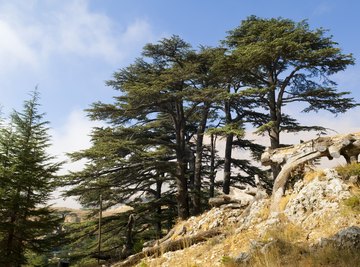
The true cedars are placed in the genus Cedrus and are limited to four very closely related species. These conifers grow in places like the Atlas Mountains of North Africa, northern India, Cyprus, Turkey and Lebanon. Many scientists think the Temple of Solomon was built with Cedrus libani, which is also called the Cedar of Lebanon. The true cedars have long straight needles, a complex cone and grow to medium height at best.
The False Cedars of North America
The false cedars of North America fall into three separate genera, Calocedrus, Thuja and Chamaecyparis. The best way to distinguish these trees is by looking at their cones. Some of the common names of the false cedars are the Alaska cedar (Chamaecyparis nootkatensis), the Port Orford cedar (Chamaecyparis lawsoniana), the incense cedar (Calocedrus decurrens) and the western red cedar (Thuja plicata). The western red cedar is most interesting, for it grows to a height of 200 feet and can live for 1,000 years.
Juniperus
Juniperus is a large genus of conifers that have pointed or scale-like evergreen needles. Another distinguishing trait is the soft, blue, berry-like cone that can contain up to a dozen seeds. Among the junipers there are two trees, commonly known as cedars. In the east there is Juniperus virginiana, known as the eastern red cedar. And in the mountains of the west coast, grows Juniperus occidentalis, which is usually called a western juniper or Sierra juniper, but on occasion might be labeled as a western red cedar.
The Wood
According to Scott Leavengood, an associate professor at Oregon State University and director of the Oregon Wood Innovation Center, the common link of all these trees is the aromatic wood. For certain, the wood of the "true cedars" has been widely known for its strong natural odor used to make incense and also for the slight red hue of the freshly cut wood. When western man discovered the same traits in a few North American conifers, the natural tendency was to label these trees as a cedar, especially because no actual specimens were available in the West.
End Result
So in the long run, it probably doesn't matter that so many trees from North America bear the name "cedar." Still, this underscores the importance of understanding scientific classification. For without any alternative system of nomenclature, the widespread use of common plant names could become very confusing. One bit of advice suggests that when discussing plant diseases and planting choices with a professional forester or horticulturist, it is a good idea to know both the scientific and common name for that plant.
References
Resources
About the Author
Henri Bauholz is a professional writer covering a variety of topics, including hiking, camping, foreign travel and nature. He has written travel articles for several online publications and his travels have taken him all over the world, from Mexico to Latin America and across the Atlantic to Europe.