


Jade has long been considered a stone of good fortune in Chinese tradition, going back for thousands of years. The Chinese carve jade into shapes that they believe enhance the stone's properties of good fortune. One popular type of carving is the “sitting frog,” or the “money frog.” The correct placement of a money frog in your home or business is vital and requires consultation with the 4,000 year-old Chinese art/science of Feng-shui.
Definition
The Chinese jade sitting frog is also known as Ch'an Chu, the money frog, and also as the money toad, according to Symbol Dictionary. Historically, this figure of a small, three-legged frog or toad is often carved from green or white jade. The frog is considered a good fortune charm, explains a University of California at Irvine article on Ch'an Chu by Amy Horwitz. Ms. Horwitz is a member of the University's Cultural Anthropology Department, under whose auspices the article was written and published.
Feng-shui Traditions
According to his study, “The Art and Science of Feng-shui,” Dr. Stephen L. Field, who is a professor at Trinity University and a researcher on the history and theory of Feng-shui, states that the earliest known historical references to the use of Feng-shui date to somewhere between 1766 B.C.and 1046 B.C. Originally used to place bodies for proper burial, according to Dr. Field's research, the art of Feng-shui now includes the proper positioning of buildings, entryways, bridges and even furniture. Ch'an Chu sitting frogs are placed using Feng-shui to protect wealth and possessions.
History
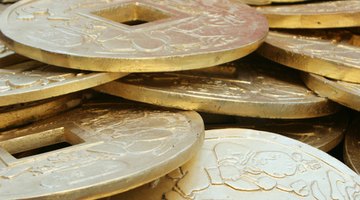
The Symbol Dictionary indicates that the sitting frog Ch'an Chu first appears in ancient Chinese folk tales. Folklore sources say the magical frog or toad prefers to hide away at the bottom of wells, according to UCI. The sitting frog could only be tempted out of the well by lowering a long string of “cash” down into the well. “Cash” was a name for ancient Chinese coins with a hole in the center, so they could be carried on a string. Once coaxed out of the well, the magical sitting frog could grant prosperity and good fortune. Jade sitting frogs are often adorned with strings of “cash” carved on their back
Description
In her UCI article, Amy Horwitz indicates that Ch'an Chu always sits on his three legs, usually guarding a small heap of coins or gold ingots. It is also typical for the money frog to hold an old Chinese coin in its partly open mouth. According to the Symbol Dictionary, the art of Feng-shui directs that the sitting frog be placed just inside the doorway of a home or business. Because it is guarding prosperity, it must always face inside.
Moon Goddess Tradition
Historically, Ch'an Chu is also associated with the Chinese moon goddess, Heng O, according to “Myths and Legends of China” by E.T.C. Werner, a Fellow at the Royal Anthropological Institute and author of several noted studies of Chinese culture and folklore. In Chinese mythology, the moon is associated with immortality and the feminine principle of “Yin,” as opposed to the masculine principle of “Yang.” Because Ch'an Chu dwells with the moon goddess, the sitting frog is able to use "Yin" energy to drive out negative energy and welcome positive “Qi” energy, according to Werner's studies.
Additional Traditions
Ch'an Chu also plays a part in the ancient annual Dragon Boat Festival in southern China, according to Amy Horwitz. This festival still takes place on May 5 every year, in accordance with the Chinese lunar calendar. Five powerful guardians--the spider, snake, scorpion, bee and Ch'an Chu, the sitting frog--are still used in this festival to help drive evil, illness and bad fortune away.
Related Articles


References
Writer Bio
Kim Norton wrote for 25 years for an in-house securities research publication. She currently writes articles for Demand Studios that involve medical research, law and senior citizen concerns. She also writes radio advertising copy and opera librettos. A graduate of Westminster Choir College, Norton resides in Bayonne, N.J.