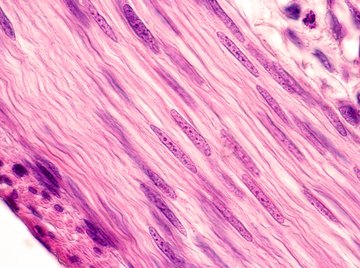

Highly specialized in form and function, each muscle cell optimally performs its required function, though there is variation amongst muscle cells within each category. Three different types of muscle cells make up the human body: skeletal, smooth, and cardiac. Humans classify them as either voluntary or involuntary, depending on whether humans consciously control their movements. Further classified by appearance, muscles can appear smooth or striated, having a striped appearance.
TL;DR (Too Long; Didn't Read)
Bodies contain three types of muscle cell: skeletal, smooth, and cardiac. Each serves a different, but important, function in human life.
Different Muscle Lengths
Skeletal muscle cells form elongated fibers in the body. They have multiple nuclei within each cell. This contrasts with the majority of other cells in human bodies. They also contain many mitochondria, cellular organelles that produce adenosine triphosphate (ATP), the body’s fuel. The short, non-striated — and, hence — smooth muscle cells contain only one nucleus. Cardiac muscle cells appear striated, though they also appear less organized into stripes than skeletal muscle cells. These cells may branch out, forming physical connections with many surrounding cells.
Different Forms, Different Functions
According to BMH Linguistics, skeletal muscle cells make up the bulk of muscles in human bodies. These muscle fibers attach to bones allowing movement in joints. As well, humans use skeletal muscles to maintain posture. Smooth muscle cells are found lining internal organs and blood vessels in humans, and they are responsible for the contraction of organs, such as the bladder. Smooth muscles act involuntary, scientists say. Cardiac muscle cells make up the heart and are responsible for pumping blood throughout the bodies of many species. Cardiac muscle is generally thought of as involuntary.
The Building Blocks of Muscles
Some scientists list more than 20 different types of proteins present in muscles. Inclusion, exclusion and amount of each protein present alter the functionality of the cell. The two major proteins, actin and myosin, appear in all three cell classes. The end-to-end arrangement of these two proteins causes the striated appearance of skeletal and cardiac muscle fibers. Smooth muscle, by contrast, contains only half the amount of myosin found in the striated muscle cells.
Muscles in Motion
A muscle cell’s ability to contract, or shorten itself, permits movement. All contraction depends on the presence of actin and myosin. Stimulation of actin and myosin bundles causes the proteins to slide toward one another, thereby shortening the fibers. Stimulation may come from a nerve signal, or it may result from the presence of charged molecules or ions the brain sends out to the muscle cell.
Energy to Feed Muscles
Muscle cell efficiency plays an important role in minimizing both excessive heat production as well as daily food requirements. Muscle cells consume ATP, the body's energy unit. The higher the contraction rate, the more ATP is required to maintain it. Skeletal muscle cells perform tasks at higher contracting rates, using a lot of ATP, although periods of rest follow bouts of movement. Cardiac muscles contract at a slow but constant rate, and so it also requires a high amount of energy use. Smooth muscle generally contracts very slowly and is considered the most efficient of the three muscle cell types.
References
- University of Leeds' School of Biochemistry and Molecular Biology: Muscle Structure and Function
- Brigham Young University-Idaho: Muscle Structure and Function
- Encyclopedia Britannica: Muscle
- Canadian Institutes of Health Research:Skeletal Muscle Research - The Most Abundant Tissue in the Human Body
- Encyclopedia Britannica: Smooth Muscle
- NCBI: Calcium regulation of muscle contraction
- Encyclopedia Britannica: Muscle Contraction
- Encyclopedia Britannica: Skeletal Muscle
- University of Leeds: Cardiac Muscle
- PLOS ONE: Squeezing the Muscle: Compression Clothing and Muscle Metabolism during Recovery from High Intensity Exercise
About the Author
Marni Wolfe began writing professionally in 2009. She has been published in the scientific journals "Brain Research" and "Endocrine," and in various online publications. Wolfe worked for more than 10 years in the pharmaceutical and nutraceutical industries before leaving to write about health and science. Wolfe holds a Bachelor of Science in genetics from the University of Western Ontario.