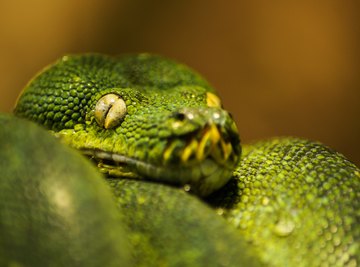
The green tree snake, or Dendrelaphis punctulatus, is also known as the common tree snake and is primarily found in Australasia. As the name suggests, green tree snakes are mainly a green color.
However, they can also appear blue, brown or black with a yellow or white belly. When trekking through the jungles of Australia, that slender, olive-green snake with a yellow head and a thin tail may well be a common tree snake.
Where Can a Green Tree Snake Be Found?
Green tree snakes are found in Australian territories, Papua New Guinea and some surrounding islands. Their range begins in New South Wales (NSW) and finishes in the northern tip of Western Australia (WA).
Across northern and eastern Australia, green tree snakes can be found in grasslands, eucalyptus forests and dense rainforests. They are the most common snakes to be sighted exploring people's backyards. They are diurnal, meaning they are active during the day and sleep at night.
How Big Do Green Tree Snakes Get?
Green tree snakes grow into medium- to large-sized snakes. When they hatch, they are around a little over 10 inches long (26 cm).
Adults typically reach between 3 to 5 feet, or 1 to 1.5 m, in length, but they have been recorded at over 6.5 feet (2 m). Females tend to be larger than males. Experts can also tell the difference between males and females by looking at their head shape.
How Many Eggs Do They Lay?
Females lay three to 16 eggs at a time. Eggs are thin and long with a width of about 2 to 8 inches (5 to 20 cm) and a length of 47 to 71 inches (120 to 180 cm). Clutches of eggs are often found incubating in soil, but they have also been found in tree stumps.
Breeding season is typically between October and December when the weather is warmer. However, the snakes' wide geographical distribution, food availability, soil humidity and temperature may all influence when females lay eggs.
How Do Tree Snakes Communicate?
Tree snakes communicate interspecifically, meaning one species can communicate with and understand other snake species. For example, through chemical cues, a tree snake in NSW will be able to understand a message left by a nearby python.
Snakes flick their tongues quickly to move any chemical signals present in the air to the vomeronasal organ, or Jacobson's organ, located on the roof of their mouth. Receptors in the vomeronasal organ then analyze the chemical signals for information about potential mates, predators or prey in the area.
What Do Green Tree Snakes Eat?
Like all snakes, they are carnivores. The size of their prey will increase as the snakes grow. The snakes are not venomous and kill their prey using their keen agility, speed and eyesight.
These small snakes commonly eat tadpoles, frogs, locusts, small skinks, geckos and lizards. Sometimes they eat fish and small mammals.
Does Anything Eat Tree Snakes?
Predatory monitor lizards will eat everything with scales and tails in Brisbane and throughout Australia, including tree snakes. Interestingly, since the introduction of poisonous cane toads into Australia, populations of monitor lizards have declined and green tree snake populations have increased.
This process is called indirect facilitation in the world of ecology. Indirect facilitation is when one species has an unintended positive impact on another species.
If They Aren't Venomous, How Do They Defend Themselves?
When the snakes feel threatened, they exude an unpleasant-smelling oil from their vent glands to startle and distract their predator. This smelly defense gives them time to escape to the safety of a nearby shrub or tree.
They may also try to scare their predator or prey, by puffing up the skin under their throat, displaying the bright blue skin under their scales and making them look larger. If all else fails, they will bite.
References
- WIRES Northern Rivers: The Green Tree Snake
- Chambers Wildlife Rainforest Lodges: Green Tree Snake (Dendrelaphis Punctulata)
- Atlas of Living Australia: Dendrelaphis Punctulatus (Gray, 1826)
- Queensland Museum: Green Tree Snake
- Biological Invasions: Indirect Facilitation of a Native Mesopredator by an Invasive Species: Are Cane Toads Re-shaping Tropical Riparian Communities?
- Wildlife QLD: Common Tree Snake
- Chemical Senses: The Function of Oscillatory Tongue-Flicks in Snakes
About the Author
Adrianne Elizabeth is a freelance writer and editor. She has a Bachelor of Science in Ecology and Biodiversity, and Marine Biology from Victoria University of Wellington in New Zealand. Driven by her love and fascination with all animals behavior and care, she also gained a Certificate in Captive Wild Animal Management from UNITEC in Auckland, New Zealand, with work experience at Wellington Zoo. Before becoming a freelance writer, Adrianne worked for many years as a Marine Aquaculture Research Technician with Plant & Food Research in New Zealand. Now Adrianne's freelance writing career focuses on helping people achieve happier, healthier lives by using scientifically proven health and wellness techniques. Adrianne is also focused on helping people better understand ecosystem functions, their importance, and how we can each help to look after them.