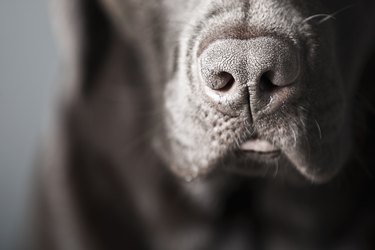
Dogs' sensitive noses make them ideal for sniffing out stashes of a variety of drugs. Although cocaine and marijuana are the most common substances that drug-sniffing dogs can smell, any drug that has the most minute scent to a dog can be sniffed out.
Marvel at the Canine Nose
Video of the Day
A dog's nose is so sensitive that it is hard to compare it to human terms. But think about how a cup of coffee might taste — or even smell — a little different when you add a teaspoon of sugar. Your dog would be able to smell that same teaspoon of sugar in the amount of water it takes to fill two Olympic sized swimming pools, according to Professor Alexandra Horowitz of Barnard College.
Video of the Day
That's because super-sensitive scent receptors in the bridge of the nose help dogs detect scents that we can't begin to conceive, including small amounts of drugs. Humans have about 5 million scent receptors in their nasal passages, according to Medical Detection Dogs. By contrast, dogs have up to 300 million, depending on their breed.
This astounding number of scent receptors spreads throughout a bony labyrinth known as the Lamina Transversa at the top of the dog's nose. Each time the dog inhales, air passes directly into this network of thin bones that are covered in olfactory receptors.
Hairlike projections known as cilia capture the scent molecules. The cilia allow the dog to hold the scent in the bony cavity even when it exhales. This allows him to continue normal respiration while he recognizes and analyzes this smell.
Unlike humans, who just have one passageway used for breathing and scent, dogs have a separate area of the nose and a large area of the brain dedicated entirely to scent. Once air is inhaled through the nostrils, it splits into two separate airways — one leading to the bony Lamina Transversa and the other taking air into the lungs.
Bloodhounds and basset hounds have the most scent-sensitive noses, according to the American Kennel Club (AKC). Other breeds such as German shepherds, Belgian Malinois, and Labrador retrievers are also popular scent dogs.
Discover the standards
Narcotics detection dogs get certified by the National Narcotic Detector Dog Association (NNDDA) to find at least two essential substances — marijuana and cocaine. They must be able to detect a stash of 10 grams minimum hidden in an area of 1,000 square feet, roughly the size of a two-bedroom apartment.
One gram of marijuana equals approximately three average-sized buds, according to Leafly. A gram of cocaine is the same as the amount of artificial sweetener contained in a single-serving packet.
Dogs and their handlers can take further training and certify their skills in detecting heroin, methamphetamine, opium, or other narcotics. Handlers must renew their dog's certification every year.
Teaching your dog to search
If your dog loves to sniff things out, it's never to early to indulge their natural talent. AKC scent work classes teach dogs to trail and track scents to find specific essential oils that include birch, cypress, anise, and clove on a cotton swab. Dogs learn to indicate that they've discovered the swabs hidden in the search area.
Local trials let dogs put their skills to the test. The competition includes finding the specified odors hidden in containers, inside a building, outdoors, and buried. The sport accommodates all levels of experience with its four categories: novice, advanced, excellent, and master.
Each dog begins nose work at the novice level and progresses through the categories for each of the four scenarios. Your dog could be a novice at containers and a master at finding scents outdoors. Increasing difficulty at each level includes more challenging elements for both dogs and handlers. Factors that change include the number of hidden swabs, whether the number of swabs is known to the handler, and the height of the hidden objects.