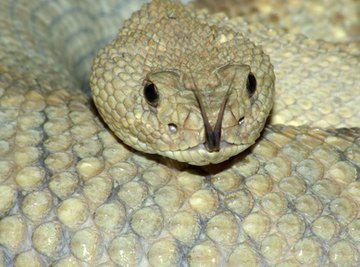

No, reptiles aren't slimy – quite the opposite, in fact. The scales that cover their bodies are dry to the touch and quite impressive. Like human fingernails and rhinoceros horns, these scales are made of a strong protein called keratin. Contrary to popular belief, scales are not reptiles' skin; their skin actually lies beneath this keratin layer, which serves many functions that help reptiles survive in the wild.
TL;DR (Too Long; Didn't Read)
Scales help reptiles with movement, defense, water retention and camouflage.
Scales Are for Slithering
The scales on some reptiles help them get moving. In the case of snakes, scales on their bellies grab onto tiny imperfections on surfaces and create friction to propel snakes forward. Modified scales resembling hairs on the underside of the feet of many gecko species, including the day gecko or crested gecko, also facilitate movement. These are called lamellae and allow the geckos to grip and climb smooth surfaces with ease.
They're a Reptile's Best Defense
Thick, prickly scales on a reptile can help protect it from predators. Scales can make it difficult for predators to bite or attack their prey and may even injure the predator. In some reptiles, the color of their scales can fool predators into backing off. For example, the non-venomous milk snake has black and red rings that resemble the pattern of the highly venomous coral snake.
Water Retention
Reptiles living in the desert have evolved special adaptations that allow them to thrive in the hot and dry climate. The scales of many desert reptile species help to retain moisture by preventing the evaporation of water through the skin. As a result, they're less prone to dehydration and require smaller amounts of water to survive.
Scales Serve as Camouflage
The scales of many reptile species are either plainly or elaborately colored to create camouflage. Certain species of leaf-tail geckos can completely blend into surrounding tree trunks and branches in their natural environment. Chameleons have an additional advantage: they can change the color of their scales at will. In the wild, the chameleon uses this ability for camouflage or to absorb sunlight by darkening parts of its body.
Modified Scales
Not all reptile scales are merely plates that coat the reptile's skin. Some have other interesting uses, such as the aforementioned lamellae in geckos. Another example: When a rattlesnake sheds its skin, a portion of the scales remains at the end of its tail. This creates a hollowed-out area full of dead scales, which the rattlesnake vibrates to create its famous rattling noise used to warn predators to stay away.